
Artist Focus: Riesbri
Cartoons, heat and the feeling of being in-between
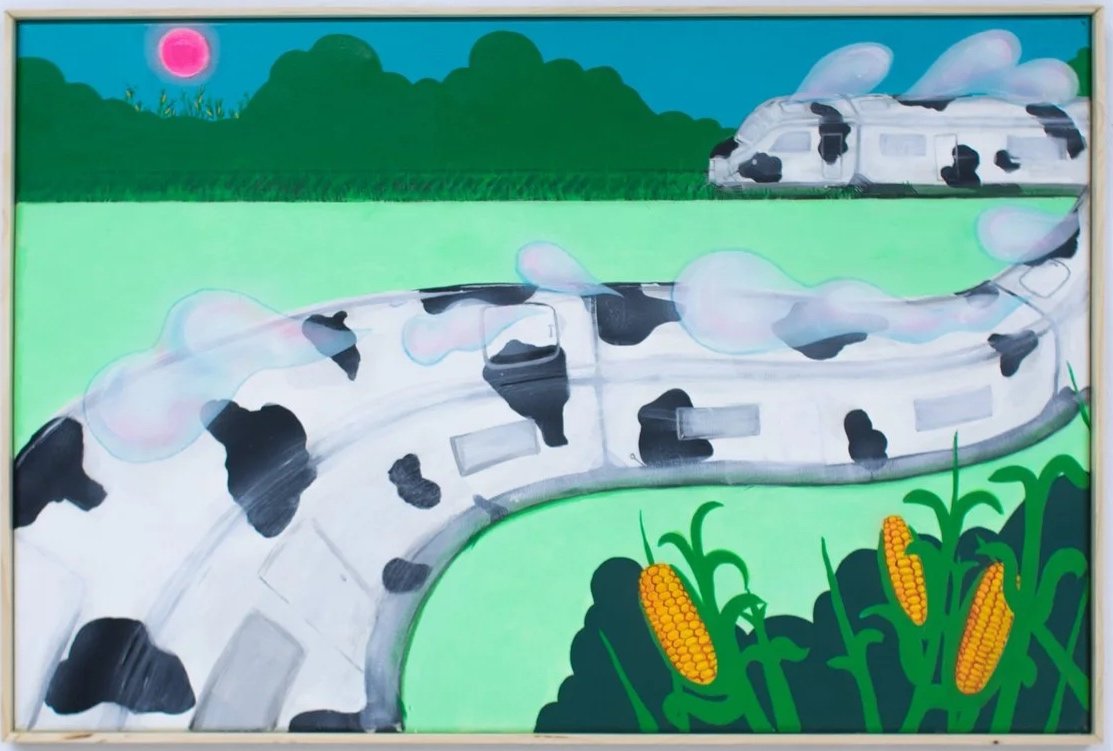
Tren lechero (Milk Train), 2022
Acrylic on Canvas
The first time I spent time with Riesbri’s work, I felt like I was looking at a cartoon I half-remembered from childhood and a dream I’d just woken up from at the same time. On the surface, the paintings feel playful: rounded characters, soft edges, bright colours. But the longer you sit with them, the more you notice what’s underneath: heat, migration, and the strange intensity of everyday life in transit.
Riesbri is a Montreal-based artist and Concordia University sculpture major whose practice moves between sculpture, painting, installation, and design. Originally from Paraguay and raised in Brazil, with a mixed Indigenous background, they now live and work in Tiohtià:ke/Montréal. Their experiences of migration, climate, and the built environment are all quietly encoded into their work. Materials like wood, metal, clay, paint, and found objects come together in pieces that sit between the organic and the industrial - between something tender and something a little bit dangerous.
Influenced by cartoon universes like Adventure Time and ideas like the Kiki/Bouba effect, their colourful forms blend abstraction and character-like shapes, making big themes - identity, displacement, ecology, care - feel personal and accessible rather than distant or theoretical.
Three countries in one image
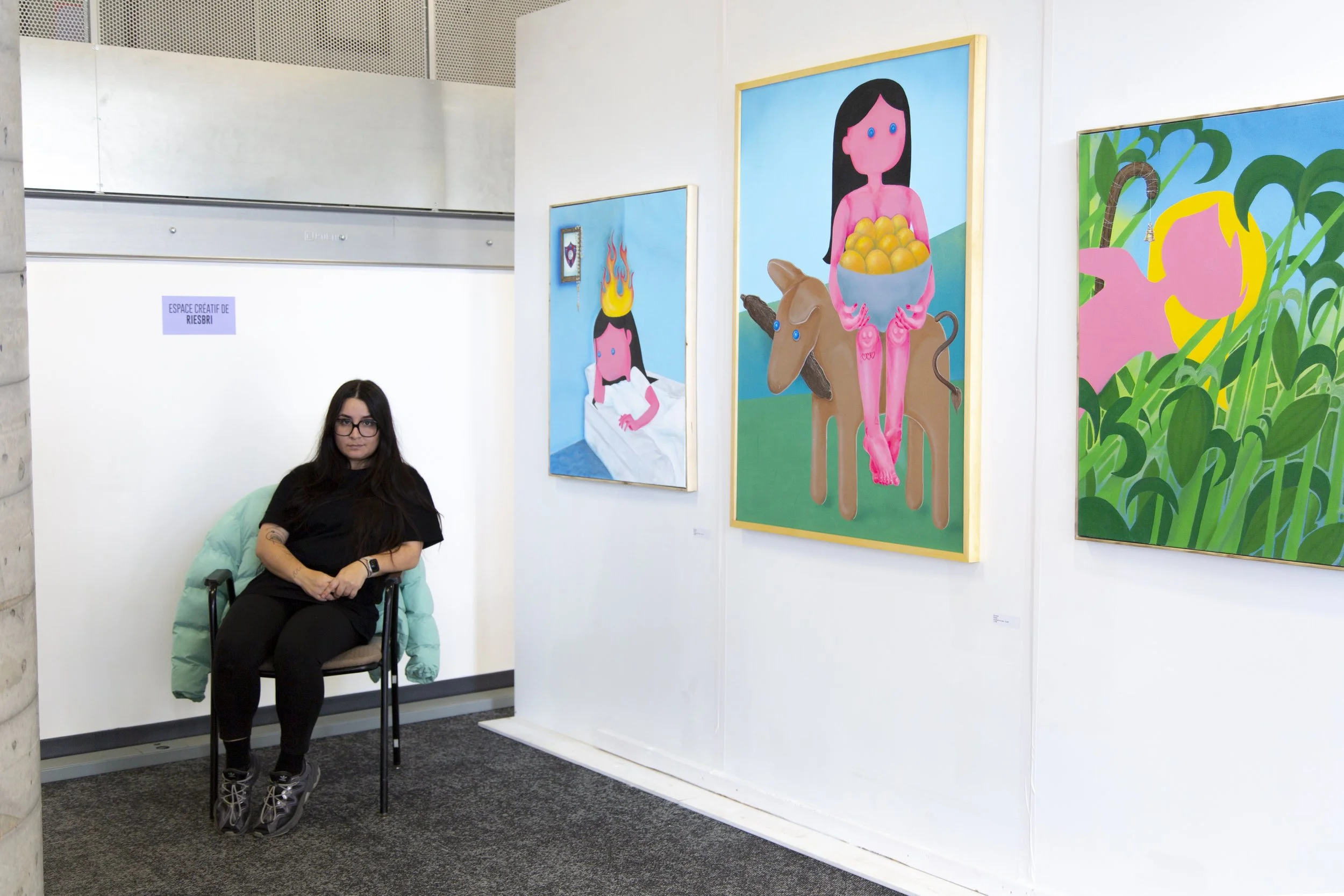
When we talked about how Paraguay, Brazil, and Montreal show up in their work, Riesbri described it as a kind of emotional layering. These places don’t appear as literal landscapes so much as traces: the texture of a tiled wall, the way an insect hovers near a screen, the colour of a sky at a particular hour, the feeling of a too-hot room.
Growing up in Paraguay and Brazil gave them a visual vocabulary shaped by heat, humidity, insects, and specific saturated colours. Montreal introduced a very different kind of climate and emotional landscape - coldness in both the literal and metaphorical sense, cultural distance, the realities of migration.
All three geographies coexist in the work. They surface in recurring motifs - stars, tiles, windows, screens, buses, waiting rooms - and in atmospheres that feel at once familiar and slightly off. The pieces on Curio Atelier, like “Tren lechero (Milk Train),” “Disimulada,” “Mosquito,” “Window,” “Screen,” “Azulejo,” and “Waiting For an Uber Ride,” carry these overlapping worlds inside them.
Cartoons, accessibility, and techaga’u
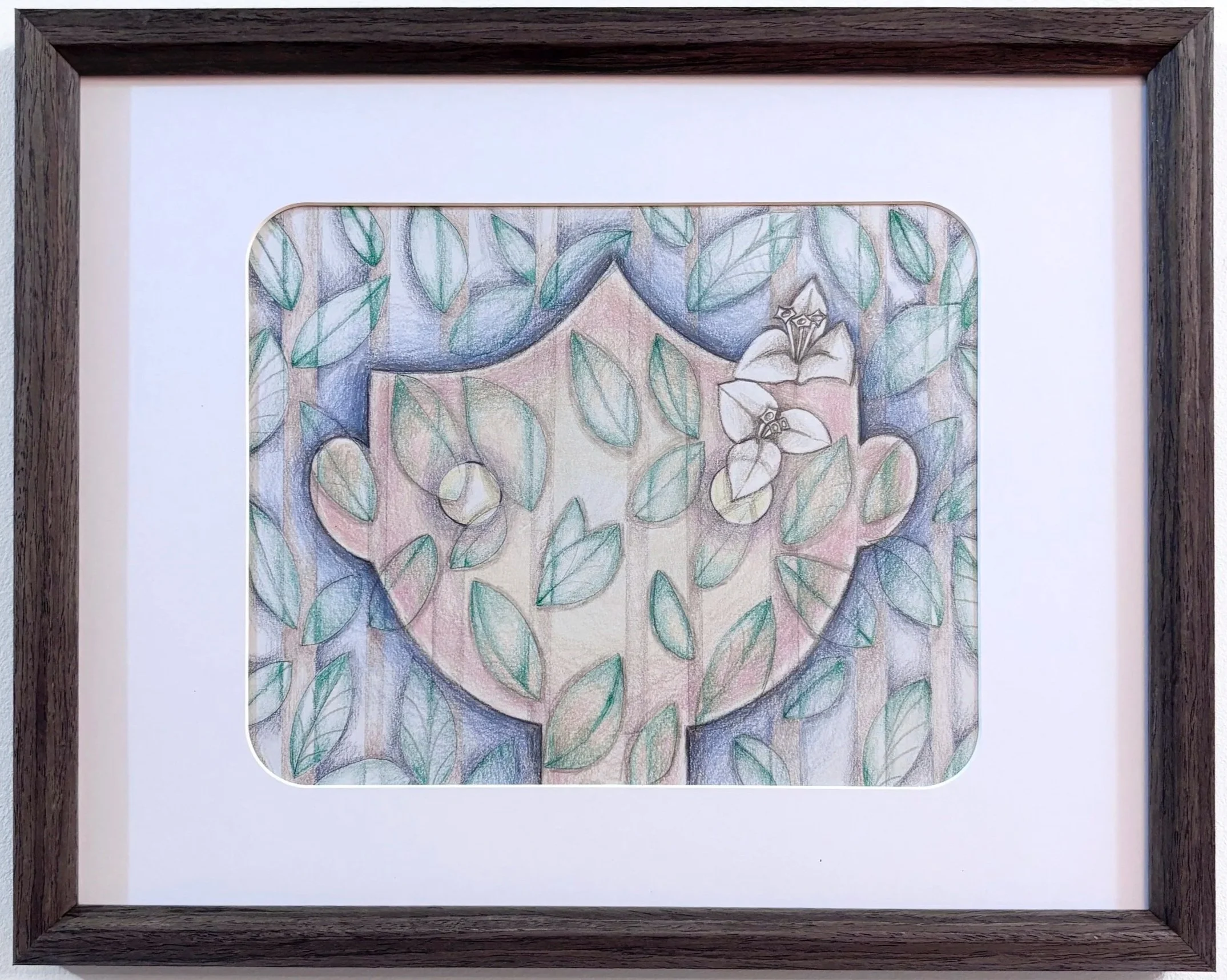
Disimulada, 2025
Coloured Pencil on Paraguayan Paper
One of the first things you notice about Riesbri’s work is the cartoon-like language: rounded forms, simplified outlines, a kind of visual softness that feels immediately approachable. That’s very intentional.
It matters to them that their work stays accessible, that you don’t need a certain education or art vocabulary to feel invited in. Cartoons were a big part of their childhood: television, early internet culture, and the aesthetics of growing up in Paraguay all helped shape how they see and draw. Even when the forms look simple or childlike, the meaning is not. The “cute” surface is a doorway, not the whole story.
They often think about the Guaraní word “techaga’u,” which describes a deep, tender, almost aching nostalgia. The cartoon language opens a soft door into the work, and behind that door are layers of memory, displacement, and lived experience.
Soft shapes, hard truths
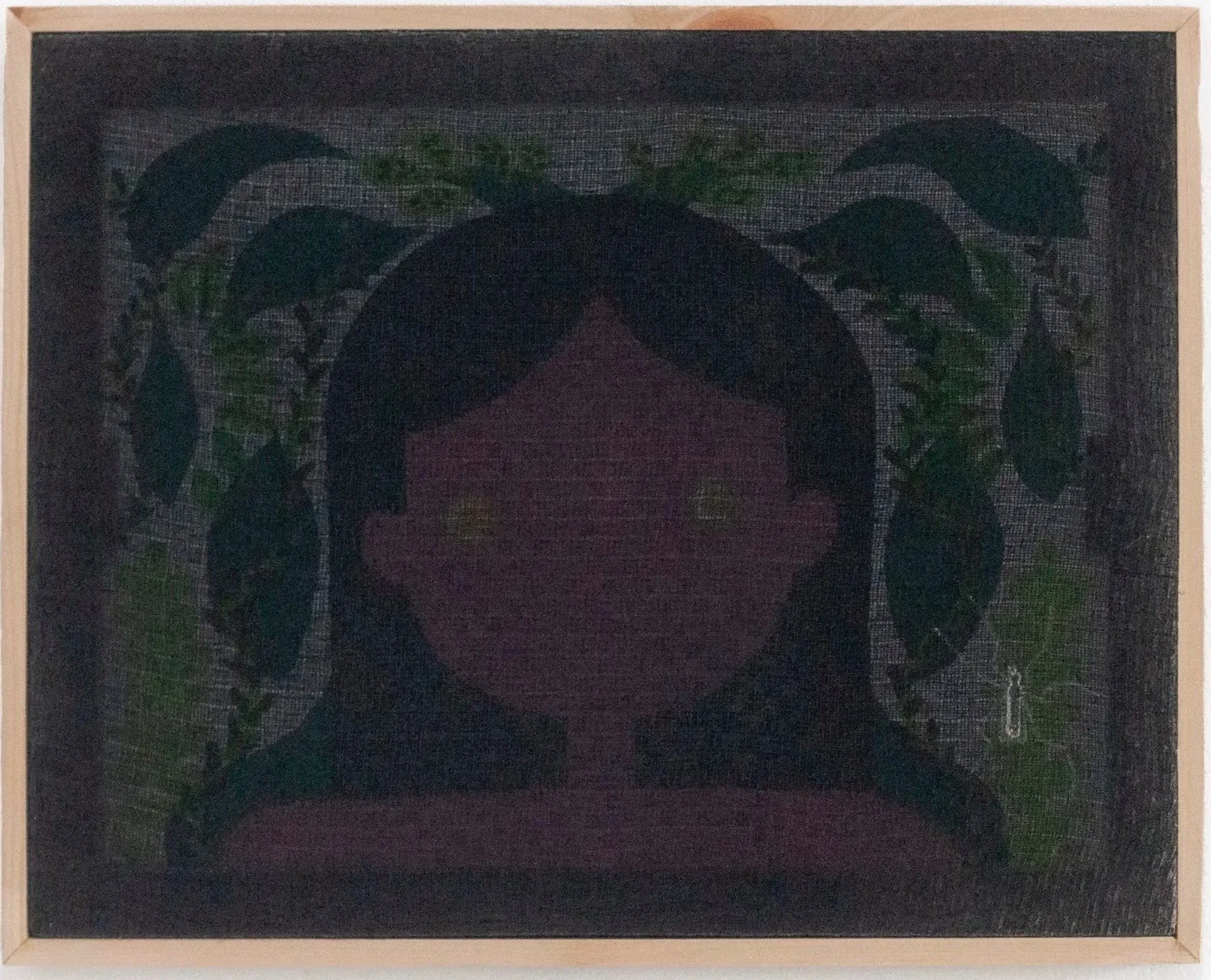
Mosquito, 2025
Acrylic on board, wood, trapo rejilla
Riesbri has spoken about their interest in the Kiki/Bouba effect—the psychological association between rounded shapes and softness, and jagged shapes and harshness. Their work leans toward the bouba side: soft, curved forms that feel friendly and safe.
That softness becomes a tool. Even when the deeper themes deal with difficult realities - migration, illness, climate pressure, colonial histories - the round forms act as an invitation instead of a barrier. We’re drawn closer before we realize what we’re actually looking at.
“It reflects how many people learn to move through the world,” they note, “with softness shaped by sharper histories.” The figures become a kind of armour made out of gentleness.
Colour as code: plasticity, petrochemicals, and our material world
Colour is another way Riesbri holds contradiction.
Rather than referencing traditional or classical palettes, they think of themselves as developing a personal palette made of contemporary hues: pigments that only exist because of recent technologies and synthetic processes. Many of the colours are bright, almost artificial, and they speak about plasticity, industry, and the material world that shaped their generation.
Acrylic paint is important here, not just as a medium, but as a symbol. Acrylics carry the history of petrochemical invention and mass production. Even when the colours feel fun or seductive, they hint at toxicity, globalisation, and the contradictions of living in a world built on plastics and extraction.
The result is a palette that can feel both joyful and uneasy at the same time.
Architecture, mosquitoes, and the spaces that shape us
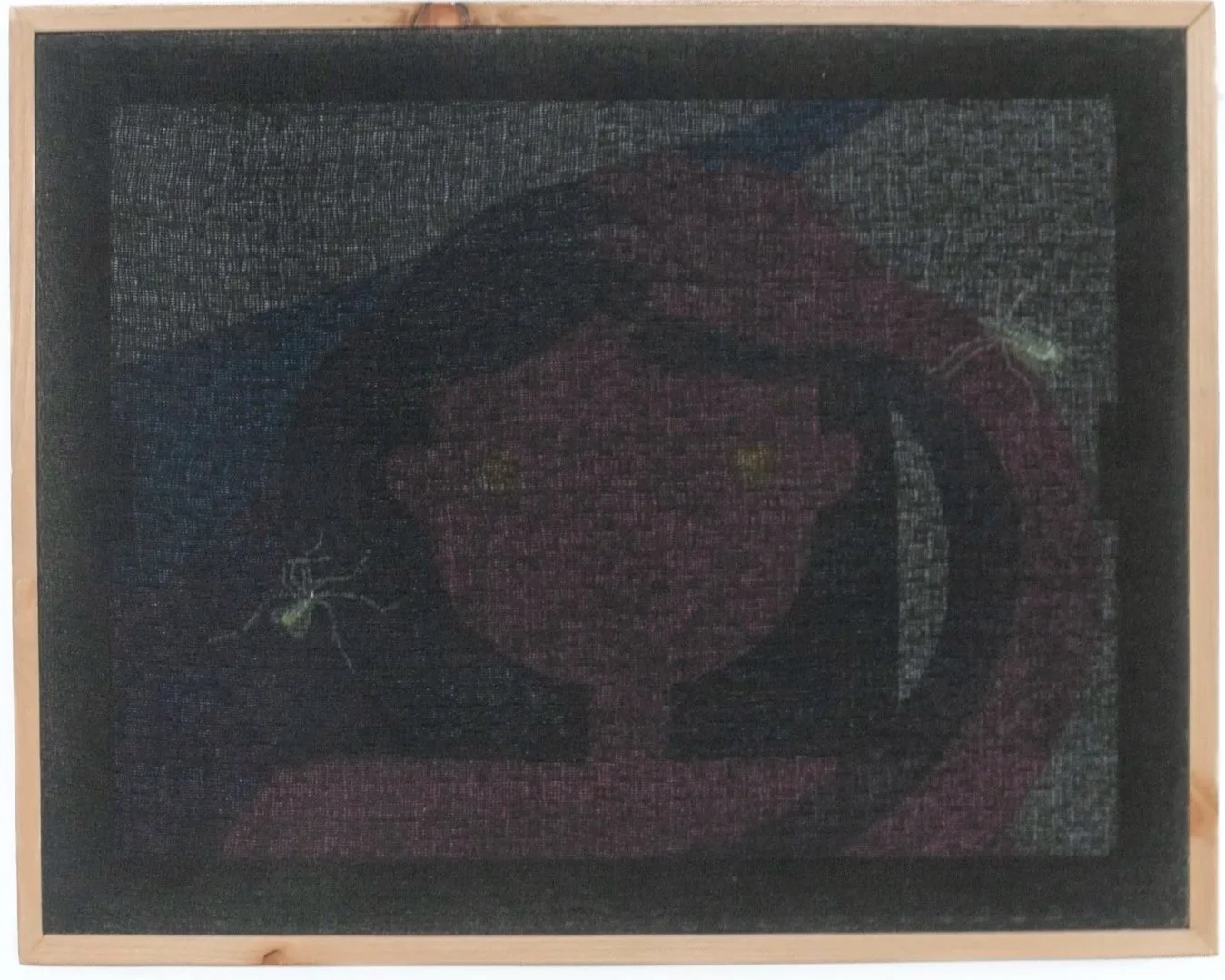
Window, 2025
Acrylic on board, wood, trapo rejilla
Several pieces in the Curio Atelier collection - “Window,” “Screen,” “Azulejo,” and “Mosquito”—centre on surfaces and boundaries we encounter every day: tiled walls, mesh screens, windows, phone-like planes. For Riesbri, these are never neutral.
Azulejos, for instance, immediately recall colonial architecture and imported aesthetics of “cleanliness” and order. These tiled surfaces are beautiful, but they also carry power and cultural pressure. They whisper about who gets to define what looks proper or desirable.
Screens are another obsession. In Paraguay, every window has a screen because mosquitoes carry very real danger, especially for elders. In “Mosquito,” what might seem like a funny or slightly absurd image is rooted in childhood memories of illness and fear: a tiny insect dictating behaviour and even architecture.
More broadly, screens - windows, phones, patterned walls - create a layer between us and what we’re trying to reach. They shape how we see, and how we remember.
Transit, waiting, and the comfort of stars
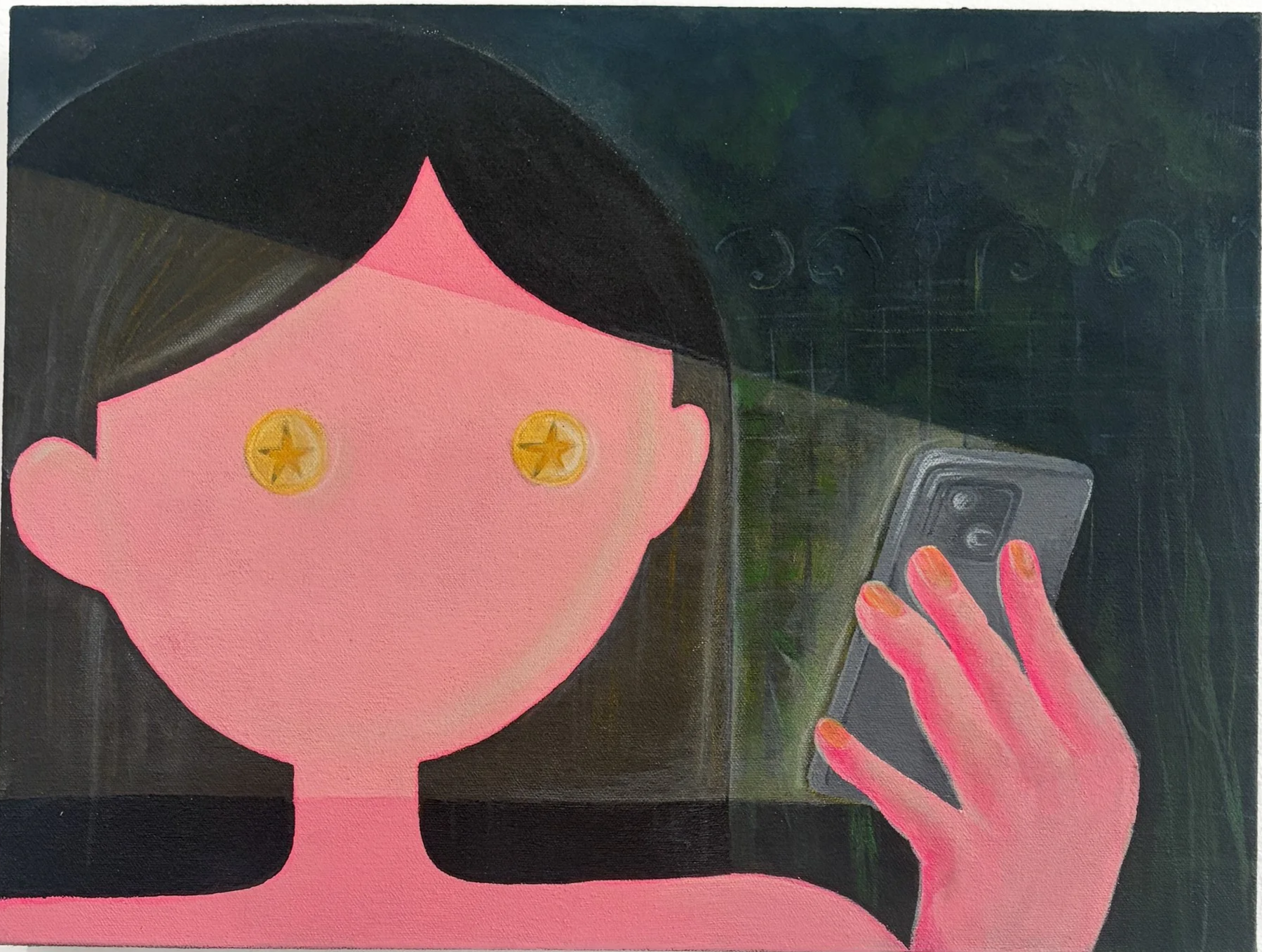
Waiting For an Uber Ride, 2025
Acrylic and Oil on Canvas
Transit and in-between spaces appear again and again in Riesbri’s work: bus stops, train rides, ride- share moments like “Waiting For an Uber Ride.” These limbos feel deeply familiar to them. As someone who has migrated multiple times, they often exist in a state of transition. Waiting for transportation, or moving between one point and another, is when they feel most aware of being unrooted.
These moments feel dreamlike: time slows down, the mind wanders, and they hold quiet emotional truths. The paintings try to bring that feeling of suspended time into a static image.
Among all these shifts, one symbol returns over and over: stars. Even though the sky changes between hemispheres, stars hold a kind of universality. Wherever you are, you can look up and find them. For someone who has moved a lot, that familiarity is grounding. It’s a simple, constant reminder that some things stay, even when everything else moves.
Calendars, caterpillars, and the long process of becoming
When I asked what object in their studio felt strangely important right now, Riesbri mentioned a 2024 calendar they can’t bring themselves to throw away. It has images of different Indigenous communities in Paraguay. Even though we’re well past 2024, the calendar might still be flipped to an early month. It refuses to move forward. It becomes a small anchor, a daily way of bringing home into the studio.
Animals appear too, especially insects. Lately, they’ve been working with caterpillars in a bronze casting residency. The transformation from soft wax to solid metal mirrors metamorphosis: something fragile becoming something enduring. For Riesbri, this echoes migration and personal change - the constant process of becoming, of turning one life into another.
Living with Riesbri’s world
What I love about Riesbri’s work is how gently it holds complexity. From a distance, the pieces feel sweet and light. Up close, they’re dense with memory, climate, tech, migration, and the tiny details of a specific childhood house in Paraguay. They remind us that our inner worlds are always leaking into our surroundings - into architecture, colour, objects, and the way we pass time between one destination and the next.
You can explore available works by Riesbri and imagine how they might live in your space through their artist page on Curio Atelier, or book a short Discovery Call if you’d like to talk through which piece might be the right companion for your walls.