
Artist Focus: Charlotte Sigurdson
Dolls, dreamscapes, and the underbelly of human nature in Charlotte Sigurdson’s work.

Charlotte Sigurdson (Winnipeg)
Acrylic and Oil on Canvas
50” x 30”
I first met Charlotte Sigurdson back when she was making dolls - tiny, intriguing figures that felt part-companion, part-sculpture, part-character pulled from a world just sideways from our own. They were technically “toys,” but even then, there was something charged and unsettling about them. They held a presence.
Today, Charlotte is a Winnipeg-based painter, sculptor, and textile artist whose work orbits the strange beauty of the human condition. Her paintings and dolls sit right at that edge between beautiful and uncanny, playful and disquieting. You can sense the doll-maker in everything: the way figures are staged, the attention to gesture, and the feeling that each piece is a character you’re meeting rather than just looking at.
Born in Toronto and having lived across Canada and in Europe before settling on the prairies, Charlotte works across oil paint, textiles, ceramics, wood, and goldwork. Her imagery is steeped in history, baroque drama, and what she calls the “grotesque sublime”: that slippery space where we recognise ourselves in things that are just a little too much, a little too honest, a little too strange.
From law career to dolls (and why “toys” were the first step)
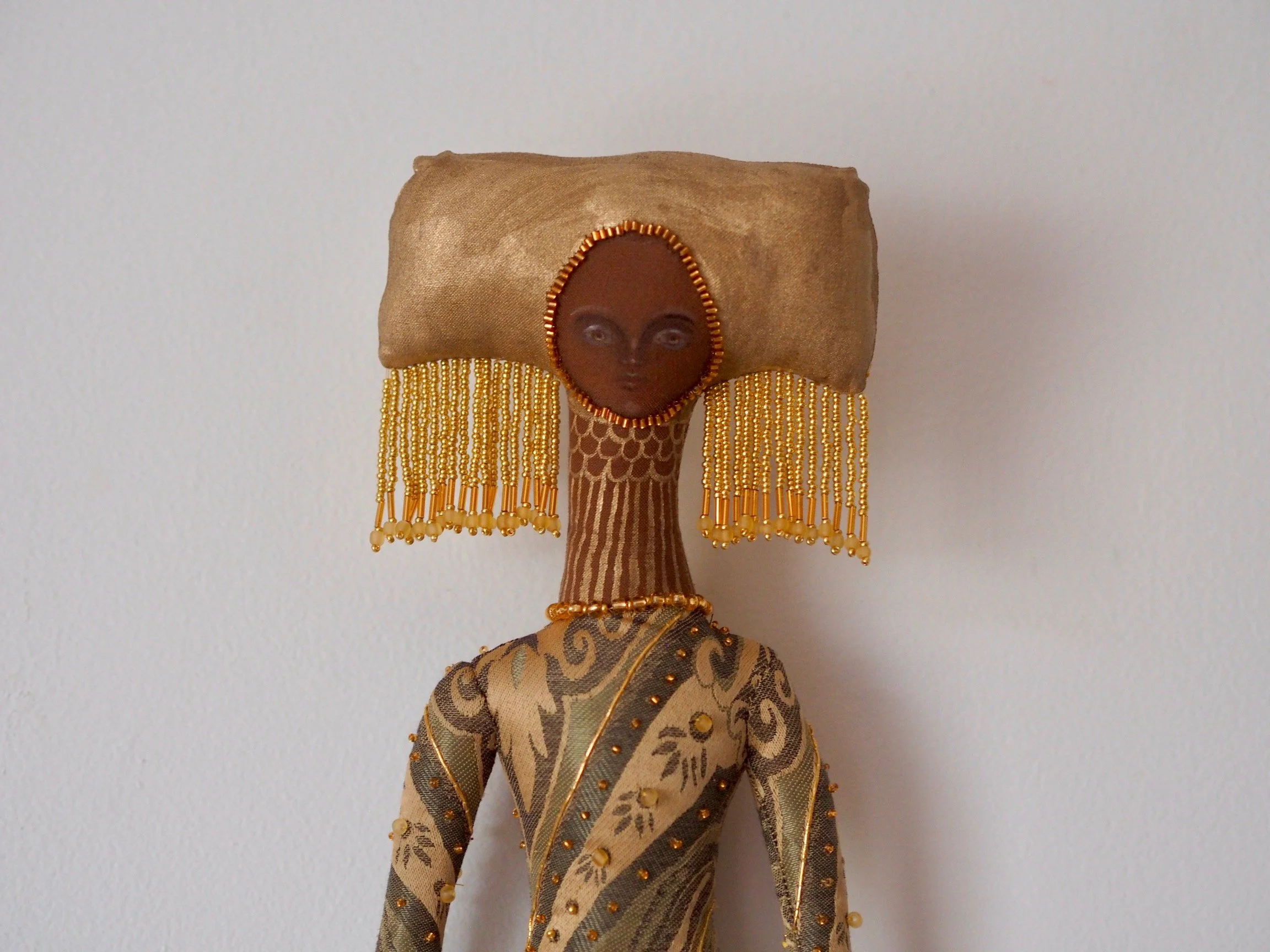
Charlotte Sigurdson (Winnipeg)
Textiles, acrylic paint, beadwork
Before all of this, Charlotte was on a very different path: law. When she left her law career, she knew she needed to do something artistic, but the idea of calling herself “an artist” felt like too big a leap. So she reached for something that had always been there: dolls.
“I’ve always been a doll person,” she tells me. As a kid, she felt strong emotional connections to her dolls; they weren’t just objects, they were companions. After having her first child, she decided to make a doll for her daughter. One doll became another, then another, and soon she found herself running a bespoke doll practice: selling at craft sales in Winnipeg, stitching characters into existence one by one. It’s such a telling beginning: even when she didn’t quite feel ready to step into capital-A Artist territory, she still found a way to build a world.
The witch doll that changed everything
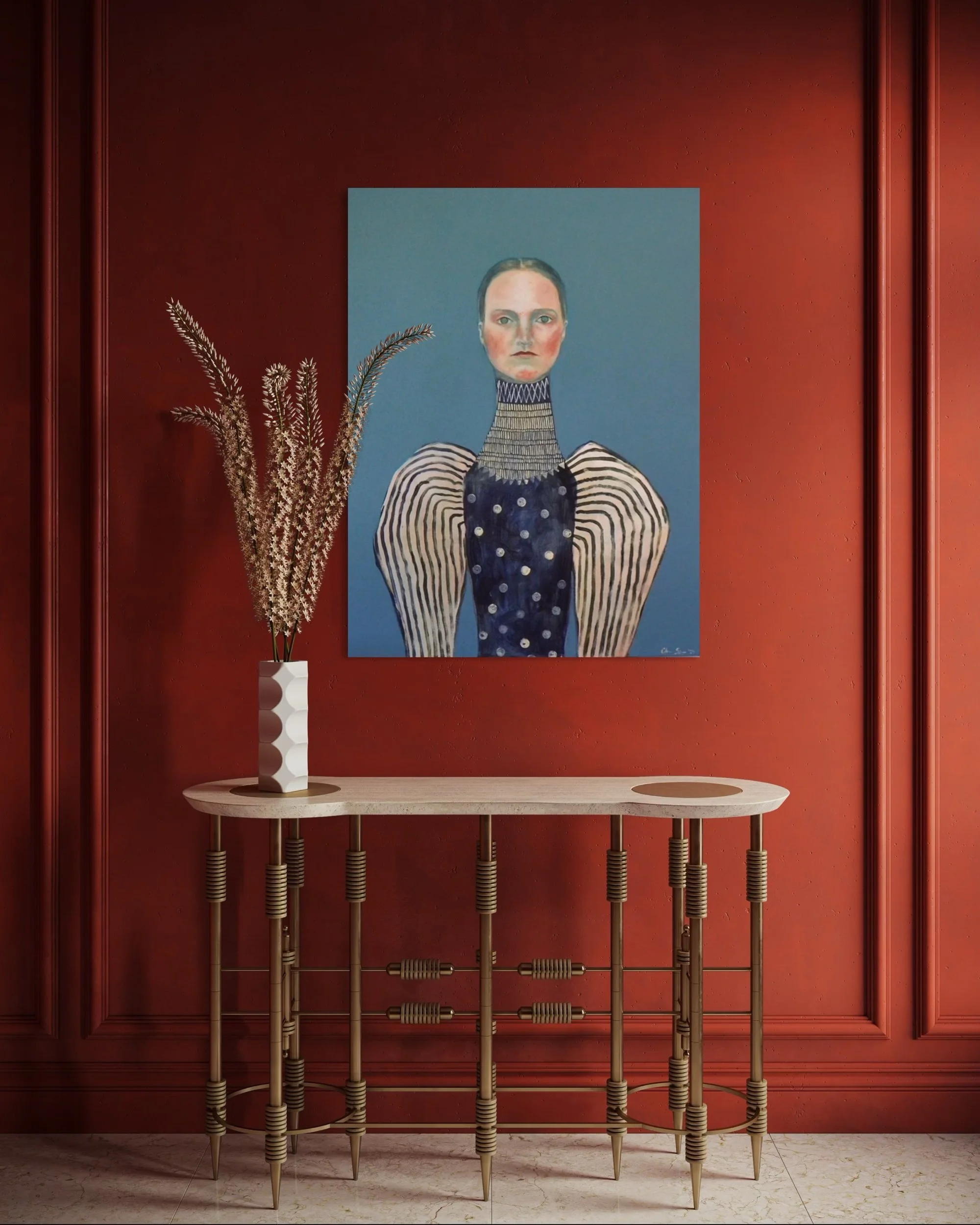
Charlotte Sigurdson (Winnipeg)
Acrylic on Canvas
There was, however, a very specific moment when “toys” no longer felt like enough.
Charlotte was showing her dolls at a popular craft market and submitted an application featuring a witch doll. It was still technically a toy, but the figure had a small bundle of dried herbs and a witch symbol on its forehead. “I thought it was cute!” she laughs. The organizers didn’t. They told her she could only participate if she left the witch at home; it was considered too offensive for some parents.
For Charlotte, that was a turning point.
In that moment she realised she didn’t want to negotiate down her ideas to fit into a commercial, family-friendly craft space. She didn’t want to keep smoothing out the edges of her imagination so nobody would be uncomfortable. If a single witch doll was “too much,” then maybe toys weren’t the right container for what she really wanted to explore.
“Okay,” she thought, “I need to move on.”
That small act of censorship was, in its own way, an invitation to step fully into fine art, where nuance, tension, and discomfort are not just tolerated but necessary. Even though Charlotte moved into the realm of fine art, dolls never actually disappeared. They simply expanded.
“I’ve always loved them,” she says. “I genuinely just want them around, so I make them and then I sell them because I have too many.” She loves that humans have been making doll-like figures for as long as we’ve existed - tiny people carved from bone, clay, fabric, wood - and that this thread runs quietly through history.
“It makes me feel connected to other people through time and space in a profound way,” she explains.
That’s why, for Charlotte, paintings and dolls aren’t separate categories: “I think of my paintings as dolls too, actually. They’re human-like representations just like dolls are. They’re like us but they aren’t us, but they’re made by us. I just love that.”
You can feel that doll logic in works like “Me Pretending Not to be Jealous,” “Kings,” “Master of Elements,” and “In Blue Mountains”—figures who feel staged and posed, but never stiff. They’re characters. They’re stand-ins for something bigger than any one person.
Beautiful, unsettling, and deeply human
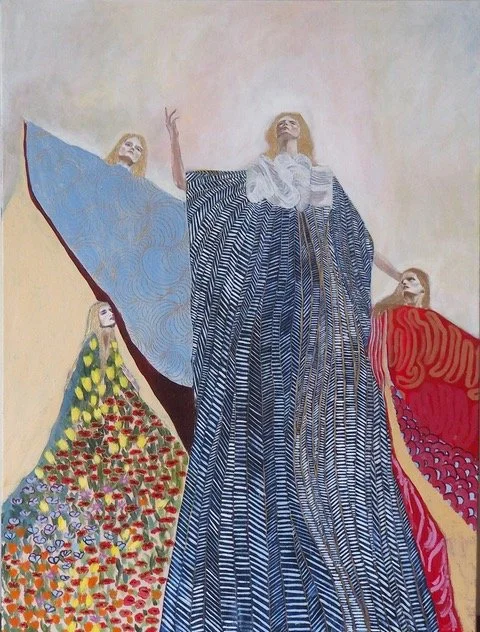
Charlotte Sigurdson (Winnipeg)
Acrylic on Canvas
Charlotte often describes her figures as facets of human nature rather than portraits of individuals. She’s not trying to capture likeness; she’s interested in the underbelly.
“I don’t want to simply represent humans as we look,” she says. “I want to represent humans as we are.”
That’s where the slight grotesqueness comes in: an elongated limb, an exaggerated hand, a face that’s just a fraction off. You don’t have to change a face very much, she notes, to make it intriguingly strange. The goal isn’t shock, it’s recognition.
She usually begins with a live model, but tells them upfront that they’re more like actors than subjects. Their job is to help her convey a concept. Over the course of painting, the image drifts further from the person and closer to the character she’s trying to find.
Sometimes she has to catch herself: she’s naturally skilled at realism and can easily overwork a painting until it’s toorealistic. When that happens, she deliberately dials it back - inviting in just enough distortion to create a productive discomfort without tipping into caricature.
It’s a delicate balance: too subtle, and the work feels merely illustrative; too pushed, and it risks losing the depth she’s after. Her best paintings live in that in-between, where you feel slightly unsettled and very seen.
Earth, arrogance, and “In Blue Mountains”
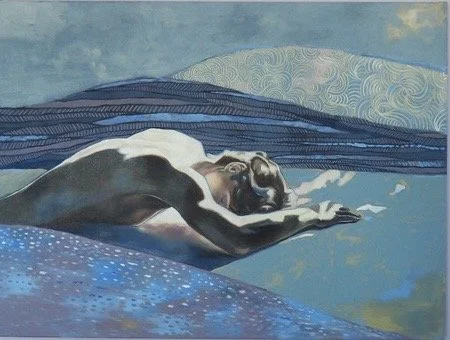
Charlotte Sigurdson (Winnipeg)
Acrylic and Oil on Canvas
In a painting like “In Blue Mountains,” currently available through Curio Atelier, there’s a strong sense of atmosphere around the central figure: distant slopes, dreamlike sky, and a character standing somewhere between belonging and detachment.
“For In Blue Mountains I was thinking about how much we are of this earth,” Charlotte explains, “and also how arrogant we can be about that. Like maybe we’d rather not be.” She’s been drawn to placing figures in front of vast, dreamy landscapes lately. Sometimes the backgrounds are more abstract; sometimes they’re specific places. Either way, they’re never neutral. “My backgrounds are important,” she says. “I always have a reason for my choice.”
In “In Blue Mountains,” the land feels both supportive and indifferent—a reminder that we are small, and yet capable of enormous impact. The figure becomes a kind of hinge between the personal and the planetary.
Paintings, dolls, and the spaces they live in
Charlotte Sigurdson (Winnipeg)
Textiles, wood, gold leaf, beadwork
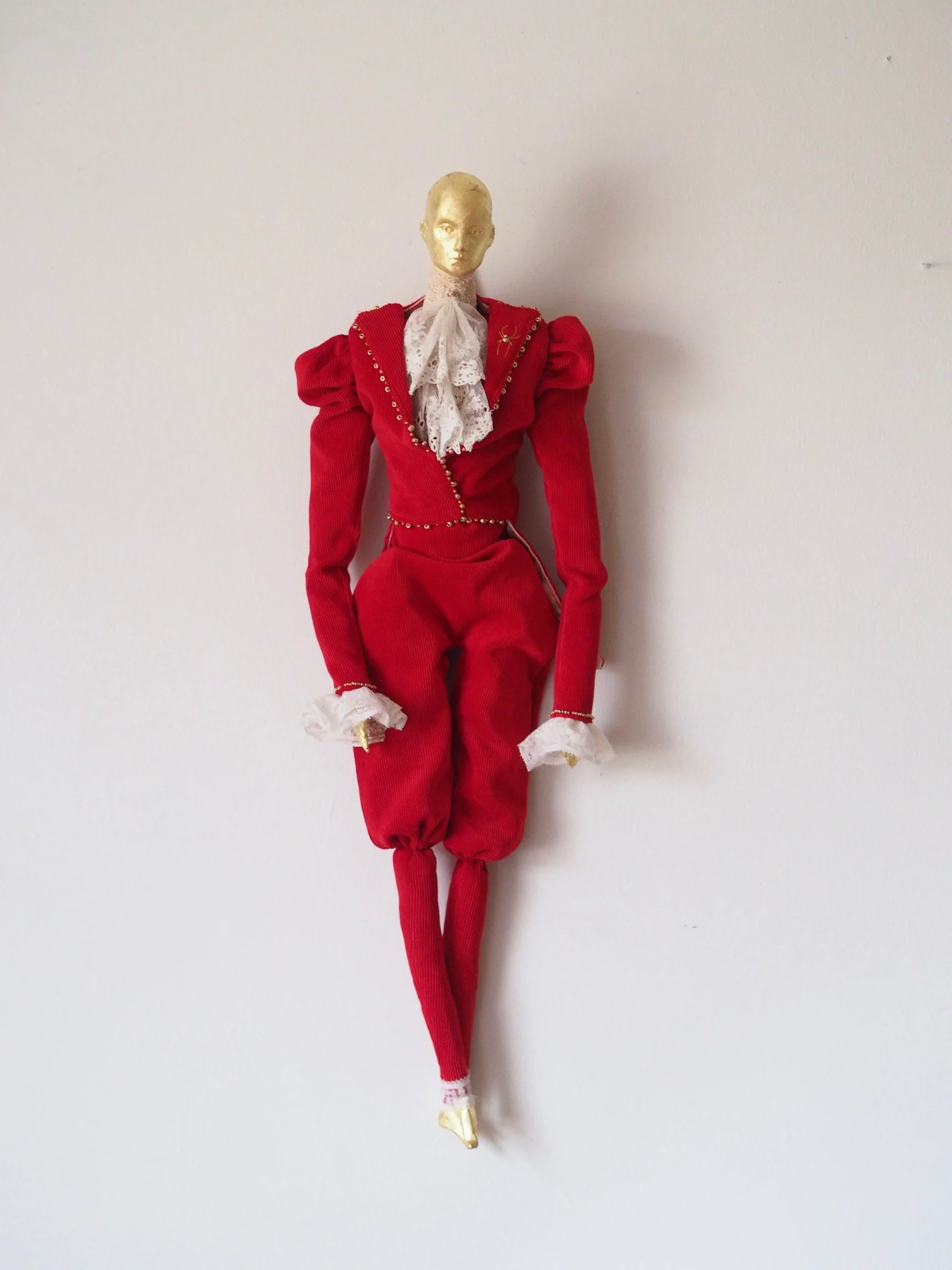
When Charlotte works on a painting with a big, clear concept, the relationship to the character is similar to her dolls: she’s building a vessel for an idea. But sometimes she makes dolls simply because she wants a doll - and those pieces feel more like new people entering her studio.
“Dolls take a really long time,” she says, “so I almost come to think of them as my little companions.”
She loves imagining where these works end up. Because her art is bold and unapologetically itself, she doesn’t picture it in “safe” spaces where everything is chosen to blend in. Instead, she imagines expressive, lived-in homes - places where you can feel the personality of the person who lives there. Homes with books, stacks of art, odd objects, and stories in every corner.
She has a special fondness for doll collectors. “I love doll collectors,” she says. “I just think they’re such whimsical people and I like when my dolls are part of a big collection.” When she knows a doll collector has bought one of her pieces, she can’t help picturing what the room looks like: shelves of tiny faces, each with its own quiet life.
Meeting Charlotte’s characters
At a recent art sale, Charlotte found herself doing something she often does at public events: scanning faces. Every now and then, one stops her. There was one woman in particular she can’t stop thinking about—a face she hopes will one day sit for her as a model.
That’s what Charlotte’s work is always circling: the spark of recognition between one human and another. The sense that, beneath different lives and technologies and timelines, we’re still puzzling over the same questions: Who am I, really? What parts of me are mine, and what’s shaped by the world? How do I live with the stranger that is myself?
Her paintings and dolls don’t answer those questions. Instead, they stand in front of us—bold, a touch grotesque, oddly tender—and say, “Look. This is us, too.”
You can explore Charlotte Sigurdson’s available works through Curio Atelier, from surreal figurative paintings like “Me Pretending Not to be Jealous” and “In Blue Mountains” to textile-based characters like “Frédéric” and “The Juggler.” If one of her figures lingers in your mind a little longer than expected, that might be your sign: this is a character who wants to live with you for a while.