
Artist Focus: Shadi Majlessi
Qajar women, modern rooms, and the quiet strength inside a turned-away gaze.
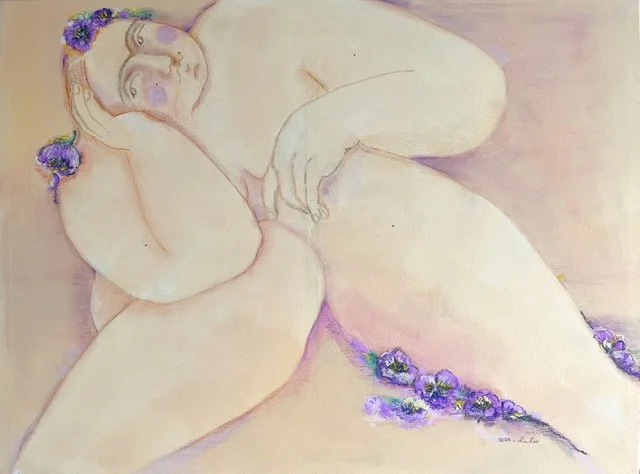
Shadi Majlessi (Toronto)
Mixed media on canvas
I’ve been drawn to Shadi Majlessi’s women for a long time. They’re full and round, yet incredibly quiet. Their eyes often look away, somewhere just beyond us, as if they’re mid-thought. Their hands are gentle but deliberate. Their necks tilt ever so slightly. The colours are rich but softened, layered with history.
These are Qajar women, but the beauty they carry feels universal.
Shadi’s practice sits at a very special intersection: Qajar-era visual language, contemporary life, and a deep commitment to rooting images of powerful women in Iranian culture rather than in borrowed Western icons. She is a painter and designer based in Toronto, and she continues to run a beloved bakery, where many of these ideas first took shape.
From cake designs to Qajar heroines
Shadi’s first encounter with Qajar imagery in her own work didn’t happen on a canvas, it happened on cake.
When she began designing cakes for the Iranian community, her intention was clear: create something truly her own, never copy templates, and never dilute her cultural references. As orders came in, she noticed an unsettling pattern. Whenever someone wanted a “strong woman” on their cake, they almost always asked for foreign celebrities, singers, or Western pop figures. In a culture with such a rich visual history, the default symbol of power had quietly shifted elsewhere.
Shadi chose to push against that. Instead of Western faces, she painted Iranian women - rooted in Qajar-era aesthetics - onto cakes and cookies. At first, this felt unusual to some clients. But slowly, people started to recognize something in these women: familiarity, dignity, a beauty that belonged to them. Within just two years, this approach made her cake designs some of the most loved and distinctive within the Iranian community. Those hand-painted cakes became a kind of training ground. Out of that world, inspired by Qajar paintings and guided by her own instincts, her signature characters emerged, and eventually moved from icing and sugar onto canvas.
What makes a Qajar woman “hers”
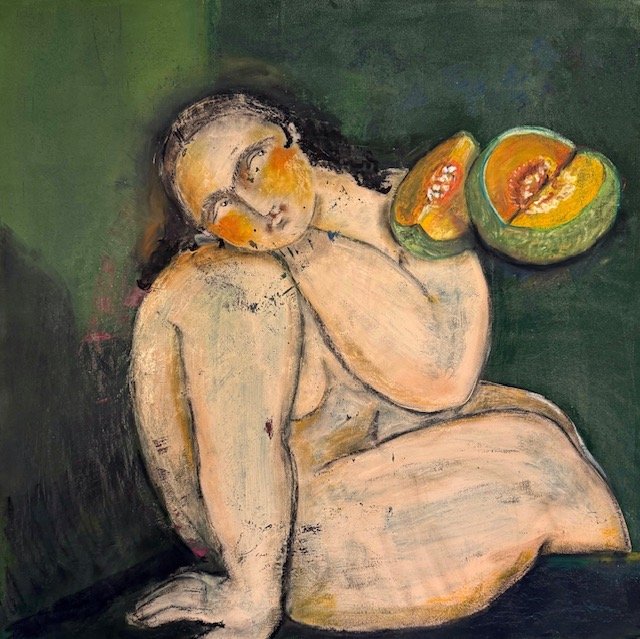
Shadi Majlessi (Toronto)
Mixed media on wood
Shadi’s figures are unmistakably Qajar, yet they are not frozen in the 19th century. They belong both to history and to now.
There are three visual elements she insists on keeping: Full, soft bodies, Center-parted, long, heavy hair, and Continuous eyebrows.
In Qajar art, fuller bodies symbolized beauty, health, and dignity. Shadi leans into that - not only as a historical nod, but as a contemporary statement. In her work, softness and fullness become symbols of comfort in one’s own body, free from modern expectations to shrink or conform. “A slim Qajar woman,” she says, “simply doesn’t carry meaning in our cultural context.” The traditional middle part and weight of the hair anchor her figures in a specific lineage. It’s a quiet, recognisable thread back to Qajar portraiture. Those uninterrupted brows represent modesty, self-respect, and cultural authenticity. They signal who these women are and where they come from.
Around these elements, she allows herself to play: adjusting palettes, placing the women in contemporary interiors, and letting them inhabit today’s emotional landscape.
Hands, bent necks, and sidelong gazes
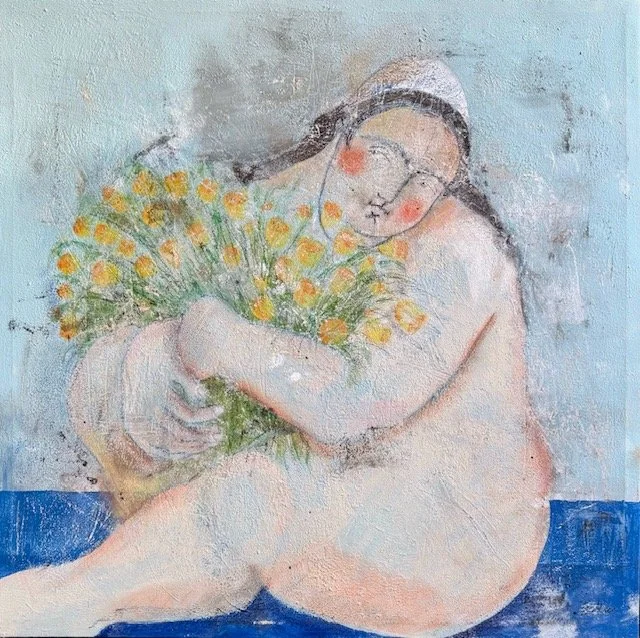
Shadi Majlessi (Toronto)
Mixed media on canvas
What I love most about Shadi’s paintings is how much they say without saying anything at all.
For her, body language is everything. The hands come first: the tiniest gestures of the fingers, the way a palm relaxes or tenses. They might seem subtle on the surface, but they hold much of the emotional weight in each piece. She often paints the neck slightly bent or tilted. That posture carries a quiet contradiction: it suggests women who are listening inwardly and following their own direction, yet are still shaped by cultural expectations and the time they belonged to. The gaze rarely meets us directly. Her figures usually look away - watchful, thoughtful, aware. Their eyes hold hesitation and knowing at the same time, as if they’re constantly navigating how much of themselves is allowed to be visible.
Put together, the hands, the bent neck, and the sidelong gaze speak to how women - especially Iranian women - have had to negotiate their presence in the world. Even in calm, beautiful moments, you feel a history of adjustment and unspoken pressure running through their posture.
A palette rooted in culture
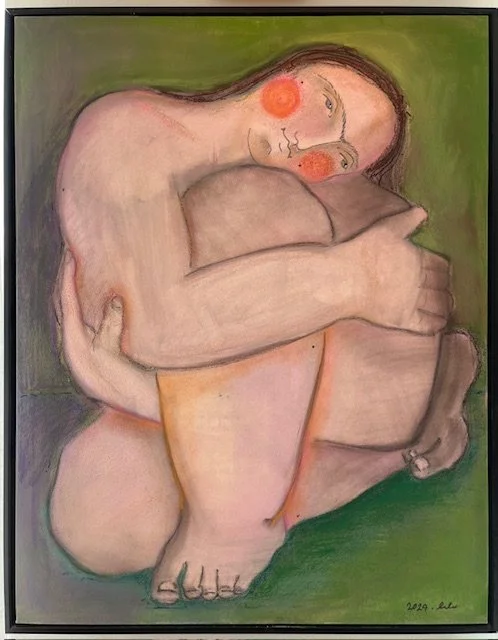
Shadi Majlessi (Toronto)
Mixed media on canvas
Shadi’s palette is one of the reasons her paintings feel so at home on a wall: it’s rich, but never overwhelming.
Red, different shades of green, and blue appear again and again. These are not arbitrary choices, they’re colours pulled from Iranian textiles, architecture, and historical imagery. They carry the echo of home. At the same time, these colours sit comfortably alongside contemporary design: plants, textiles, lived-in spaces. They’re both rooted and modern.
In recent works, Shadi often adds a dust-like white layer or a soft black veil over her colours. That extra layer is important. It suggests the passage of time, history settling on the present. It gently softens the image, allowing the painting to merge into a room without losing its depth. The result is an image that feels like memory and presence at once.
Where these women like to live
When Shadi imagines her paintings hanging in someone’s home, she thinks about the people first.
Many of her collectors, she’s noticed, are sensitive and detail-oriented. Their homes aren’t minimalist showpieces, but they aren’t chaotic either. They tend to be spaces with good light, texture, plants, and thoughtful objects - places where textiles, books, and everyday rituals matter. She loves seeing her work in rooms like that, where the painting can breathe, and where it feels like one voice in a larger conversation rather than a decorative afterthought.
One thing she learned through her collectors’ eyes is that her work often carries a subtle humour she hadn’t fully named herself. People tell her the paintings feel serious, but with a small, playful undercurrent - something that invites reflection without heaviness. That discovery has been a quiet joy for her: realizing that her women can hold both gravity and a gentle, knowing smile.
Living with Shadi’s Qajar women
What draws me to Shadi’s portraits, and why I wanted so much to share them through Curio Atelier, is this balance: they are deeply rooted in a specific culture and history, yet they feel immediately relatable, no matter where you come from. Her women are unmistakably Qajar, yet they carry a universal beauty: full, thoughtful, dignified, quietly complex.
They don’t demand attention in a loud way. They sit, they think, they hold their own space, and over time, they begin to feel almost like companions - witnesses in the room, holding stories of their own while gently reflecting ours back to us.
You can explore Shadi Majlessi’s available works through Curio Atelier, and if one of her Qajar women lingers in your mind, that might be your sign that she wants to live with you for a while, bringing her quiet power, her humour, and her long, deep gaze into your everyday life.