
Artist Focus: Laura Thipphawong
At the edge of the story: portals, fairy tales, and feelings you can’t quite name
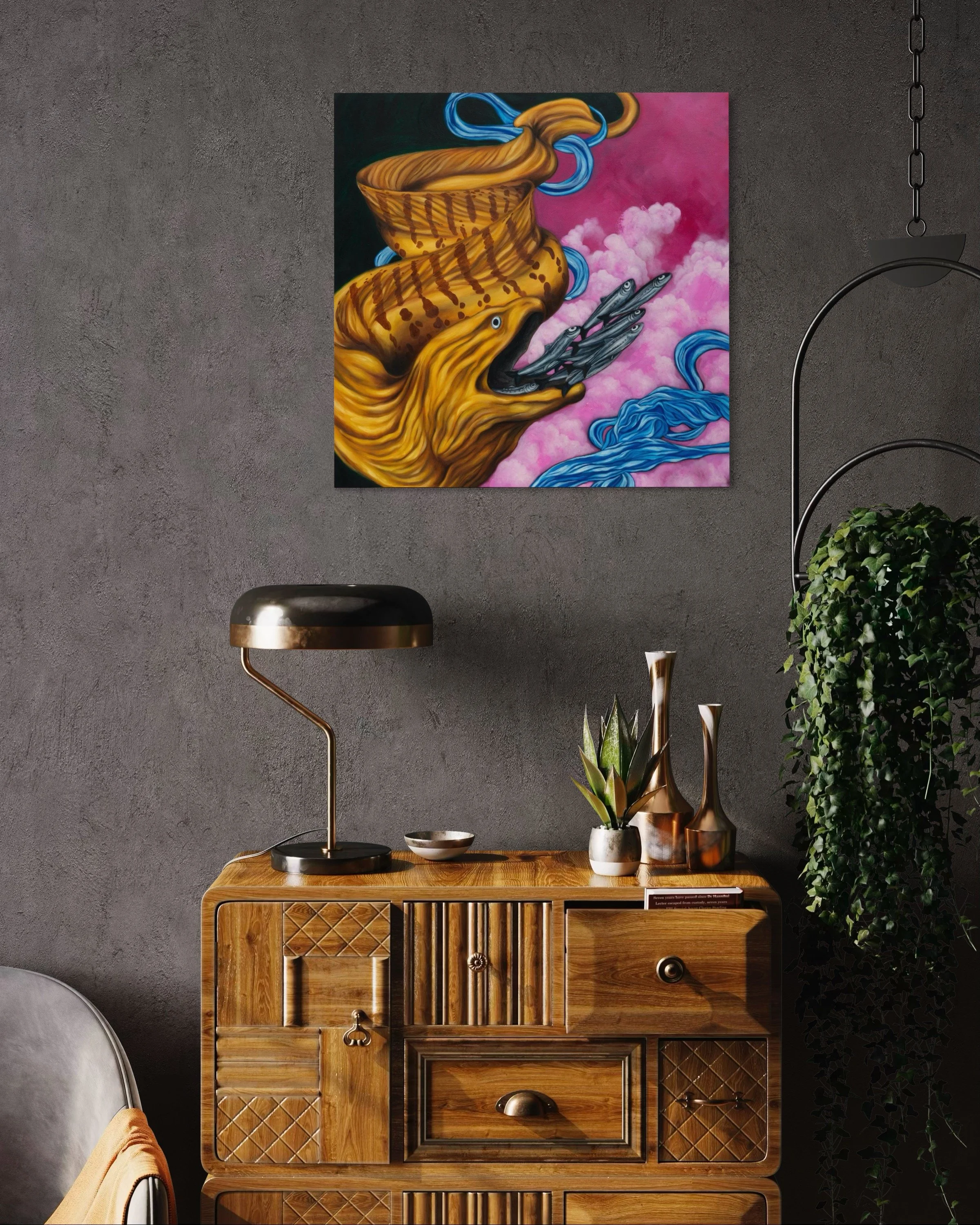
Laura Thipphawong (Toronto)
Oil on Canvas
24” x 24”
Some paintings feel like windows. Laura Thipphawong’s feel like portals.
You don’t just look at them, you wander through them. Her worlds are lush with colour and detail: women mid-transformation, animals emerging from human limbs, landscapes that feel part forest, part dream logic. At first the scenes seem playful and imaginative; then you notice teeth, talons, lava, shadows. The works draw from nature, folklore, and symbol, but they gather in compositions that are entirely her own: dense, unexpected, and full of that “something is about to happen” stillness.
You can sense, standing in front of her paintings, that there is a big, layered story underneath. A personal one, a research-driven one, and something in between. At Curio Atelier, the works we’ve brought into Laura’s orbit feel like they belong to the same universe: surreal, narrative oil paintings steeped in symbolism and psychological depth, but also open enough to invite your own reading.
Self-taught Laura and research-Laura, working together
Laura describes herself as a self-taught painter since the age of twelve, but that’s only half the story. The other half is deeply academic: a later dive into art history, critical theory, and the kind of reading that leaves pencil marks all over the margins.
Her path hasn’t been linear. She was showing in galleries as a teenager, exhibiting in Toronto in her early twenties, but she didn’t go to OCAD until she was 29, and when she did, it was to study critical and cultural theory, not studio painting. She’d already taught herself how to paint from books and trial and error; school gave her space to formally study history, sociology, philosophy, psychology, anthropology, literature, and media. All of that now folds back into her visual work.
“The self-taught part of me and the formally educated researcher part of me are still working together,” she says, just in a more productive way now. You can feel that collaboration in the paintings: the intuitive, self-directed maker and the meticulous researcher, each nudging the other.
How a painting begins: a recurring thought, then a tableau
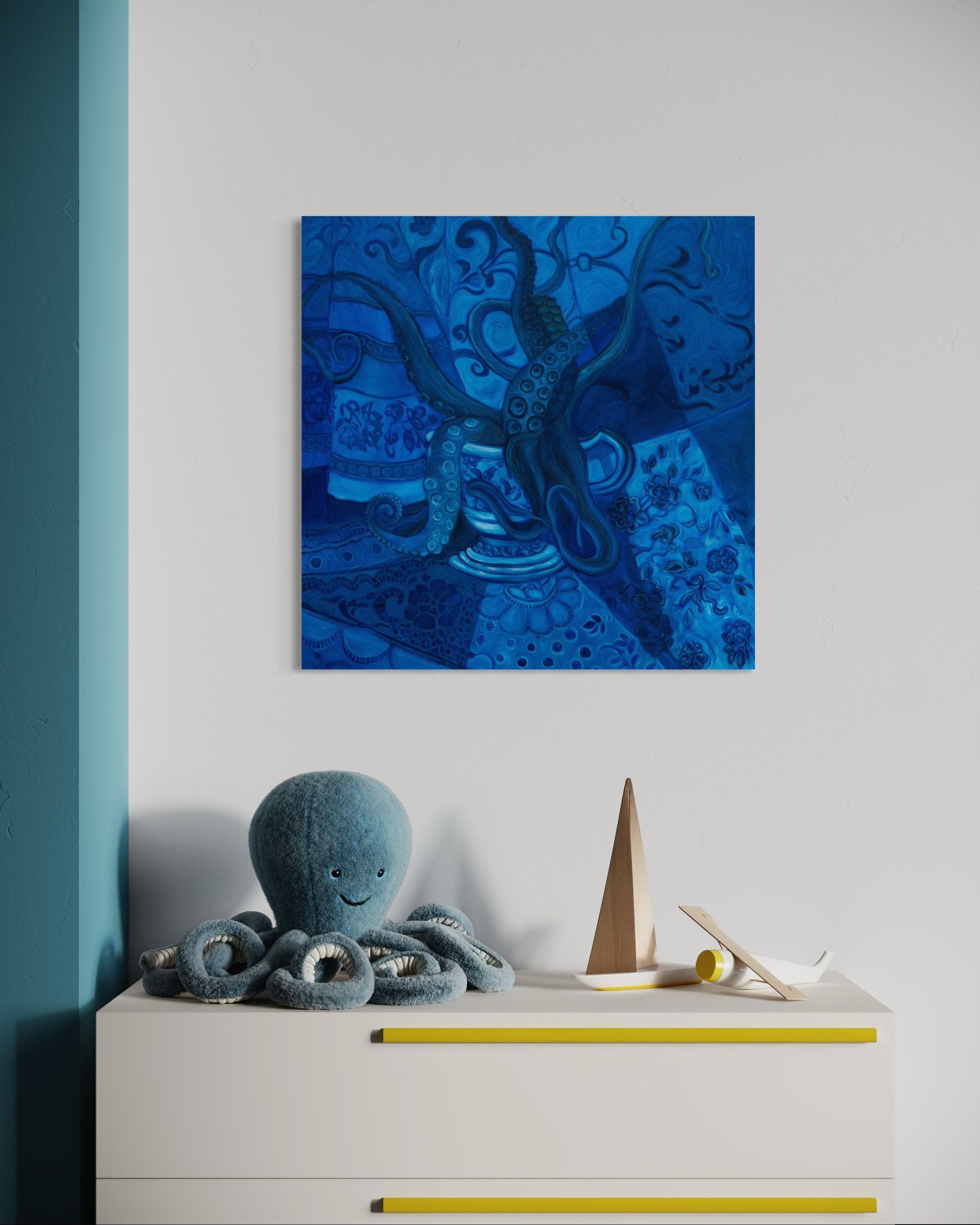
Laura Thipphawong (Toronto)
Oil on Canvas
24“ x 24”
In her bio, Laura calls her work “surreal, narrative oil paintings steeped in research and symbolism,” and that’s exactly how they behave.
When a painting begins, it rarely starts with a neat, finished story. Instead, she notices a recurring image, phrase, or concept in her thoughts – something that keeps circling back. She sits with it until it forms a tableau that “feels just somehow right.” Only then does she research the histories or theories behind the images she’s assembled. If the meaning resonates, she’ll elaborate with added symbols; if not, she pares back and paints. Sometimes it’s more direct: emblematic objects stitched together to quietly mark a personal experience.
It’s part psychological exercise, part visual composition. Each painting becomes a kind of thinking space, where ideas from fairy tales, horror films, theory texts and lived experience coexist.
Safety, danger, and the moment before something happens
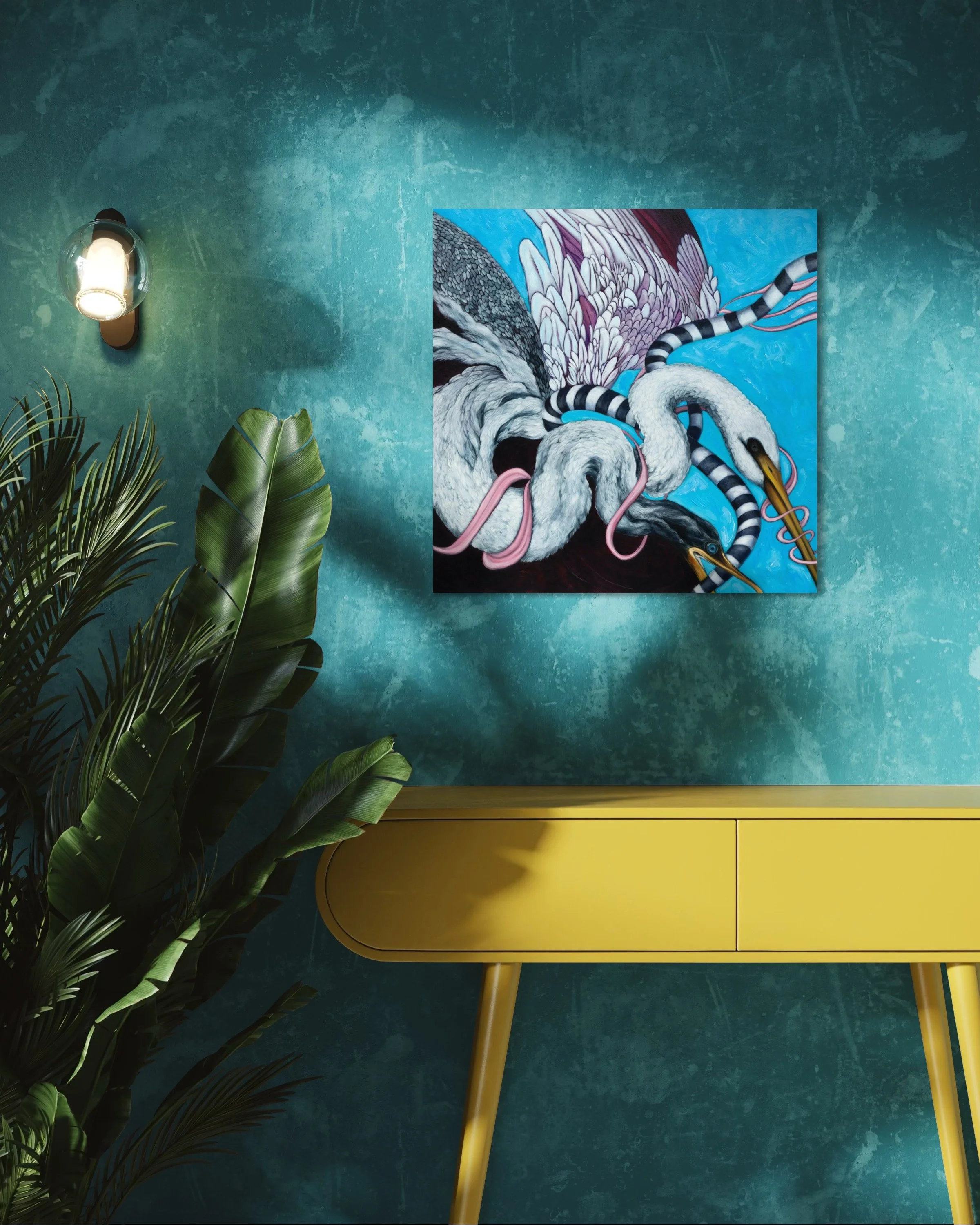
Laura Thipphawong (Toronto)
Oil on Canvas
24” x 24”
At the heart of many of Laura’s compositions is a tension: predator and prey, beauty and grotesque, human and animal, body and environment. The dichotomy she returns to most often is safety versus danger.
She’s thought about that pairing since childhood. Her thesis was on horror as an artistic genre and the cultural influences that shape it. In works like A Dangerous Game, where girls sit above a floor of lava, you see this directly: the flirtation with risk, the integration of fear as part of life rather than something to avoid at all costs.
Her paintings are often described as feeling like “the stillness right before something is about to happen,” a description she loves. That sense of being on the cusp – of standing at the edge of a decision, a transformation, a revelation – is where she is most interested in staying.
Emotionally, she isn’t looking for simple feelings. She’s drawn to ambiguous, layered, even contradictory states: those “I’m not sure what this is, but I feel it” moments. She wants to name those emotions, but not flatten them. As long as she can be honest in the way she paints them, she trusts that viewers will feel something too, even if they can’t articulate exactly what.
Human, animal, and the uncanny in between
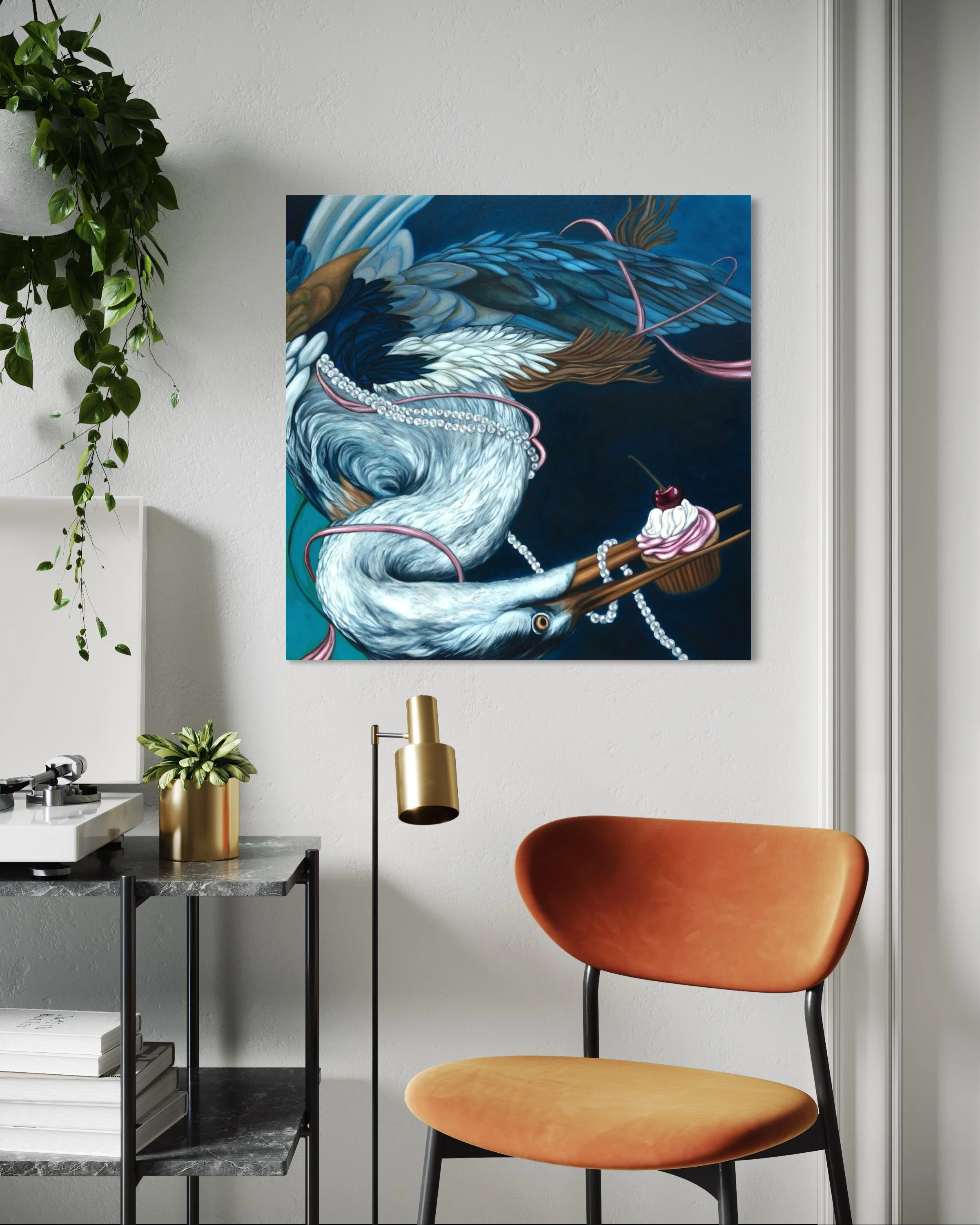
Laura Thipphawong (Toronto)
Oil on Canvas
24” x 24”
One of the most striking aspects of Laura’s work is how bodies behave. Human and animal forms often appear mid-transformation: a hand emerging from an eagle’s talons, a woman crouched with frog-like limbs, features that are almost normal until you look a little longer.
She traces this interest back to fairy tales and folklore – stories where humans morph into animals in response to trauma or danger. To her, those motifs read like visual metaphors for dissociation, for the feeling of not fully recognizing yourself.
The uncanniness isn’t random. She knows a figure is “right” when the physicality of the painting matches how the feeling lives in her own body. A reaching hand must look as if it’s straining; a crouched woman must have legs and a spine that feel just a bit too long, just slightly off. At first glance, you might see a girl and an animal; with time, you realize every limb has been quietly altered to register a deeper psychological state.
Some symbols are deeply, almost embarrassingly personal. For a period, a recurring character she called “Ghosty Boy” appeared in drawings and paintings. He represents her brother, who was stillborn less than a year before she was born. Laura grew up in a grieving family; this person who never lived still feels inexplicably close.
“It’s complicated,” she says. “I wish I knew him, but if he had lived, I wouldn’t have been born.” That paradox – love for someone who had to die for you to exist – is the kind of emotional knot that sits beneath many of her images.
Paintings as portals and companions
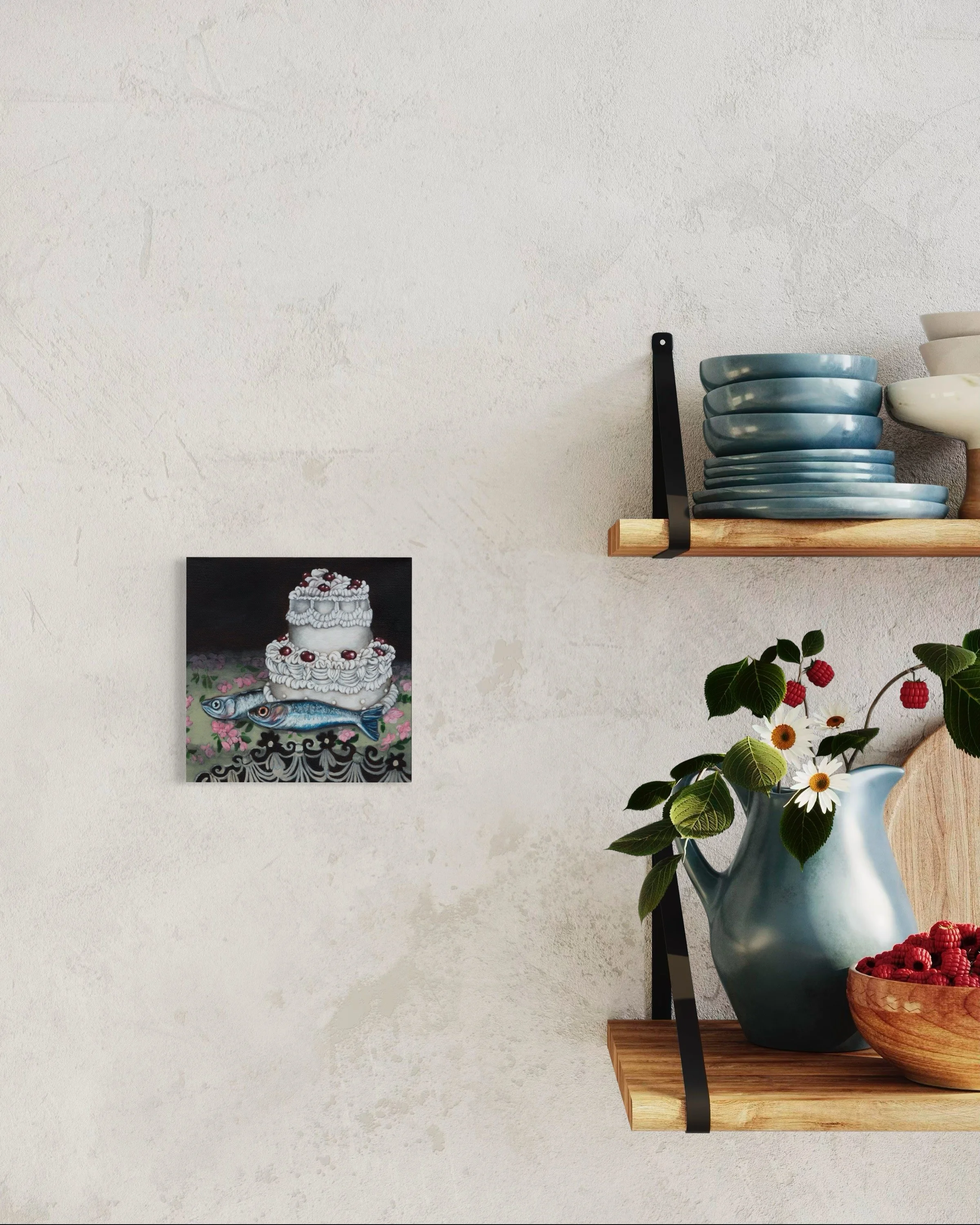
Laura Thipphawong (Toronto)
Oil on Canvas
8” x 8”
When a work leaves Laura’s studio and enters someone’s home, she quietly hopes it changes the atmosphere.
“I hope it creates an otherworldly, cerebral atmosphere,” she says. Ideally, people want to spend time with the image, to almost step into it as if it were a portal. That feels exactly right for how her paintings behave at Curio: they don’t just sit above a sofa as decor; they tempt you into looking longer than you meant to, noticing new connections between elements each time.
Occasionally, a collector’s reading sends the work back to her in a different light. A recent example is the painting of a woman turning into a frog – a work Laura rooted in fairy-tale motifs and personal experiences. The collector who bought it sees it as a “cosmic interplay among humans and nature, and of time, memory, and grief.” Those themes are close to what she was thinking, but hearing them articulated so thoroughly made her feel as if the painting wasn’t hers anymore, in a good way. It had become a shared object, carrying meanings she never could have engineered alone.
Where the universe is headed next
The works currently on Curio Atelier feel like they all belong to the same universe: natural elements that feel like symbols pulled up from the subconscious, and compositions that keep revealing new details the longer you look.
If Laura imagines the “next chapter” of that universe, she sees herself moving further into narrative, figurative territory. After a period of working with more emblematic, externalized imagery, she’s now returning to something more personal and story-driven: women exploring strange worlds in a raw, organic, yet magical style.
She talks about “controlled maximalism” – compositions full of detail, but held together with intention. There’s a renewed indulgence in fun and joyful images, mingled with deeply personal narrative elements she had recently set aside. She feels this new work might be her best yet, and, importantly, she’s having a great time making it.
For Curio, that’s one of the most exciting things about Laura’s practice: these paintings are serious, researched, and emotionally complex, but they also make space for play, curiosity, and the pleasure of getting lost in an image. They invite you to stand in front of them in your own small room and feel, for a moment, as if you’re standing at the threshold of another world, one that’s a little frightening, a little funny, and entirely alive.