
Artist Focus: Alexandra Swistak
They Drink From Flowers – women, bees, and the quiet power of belonging
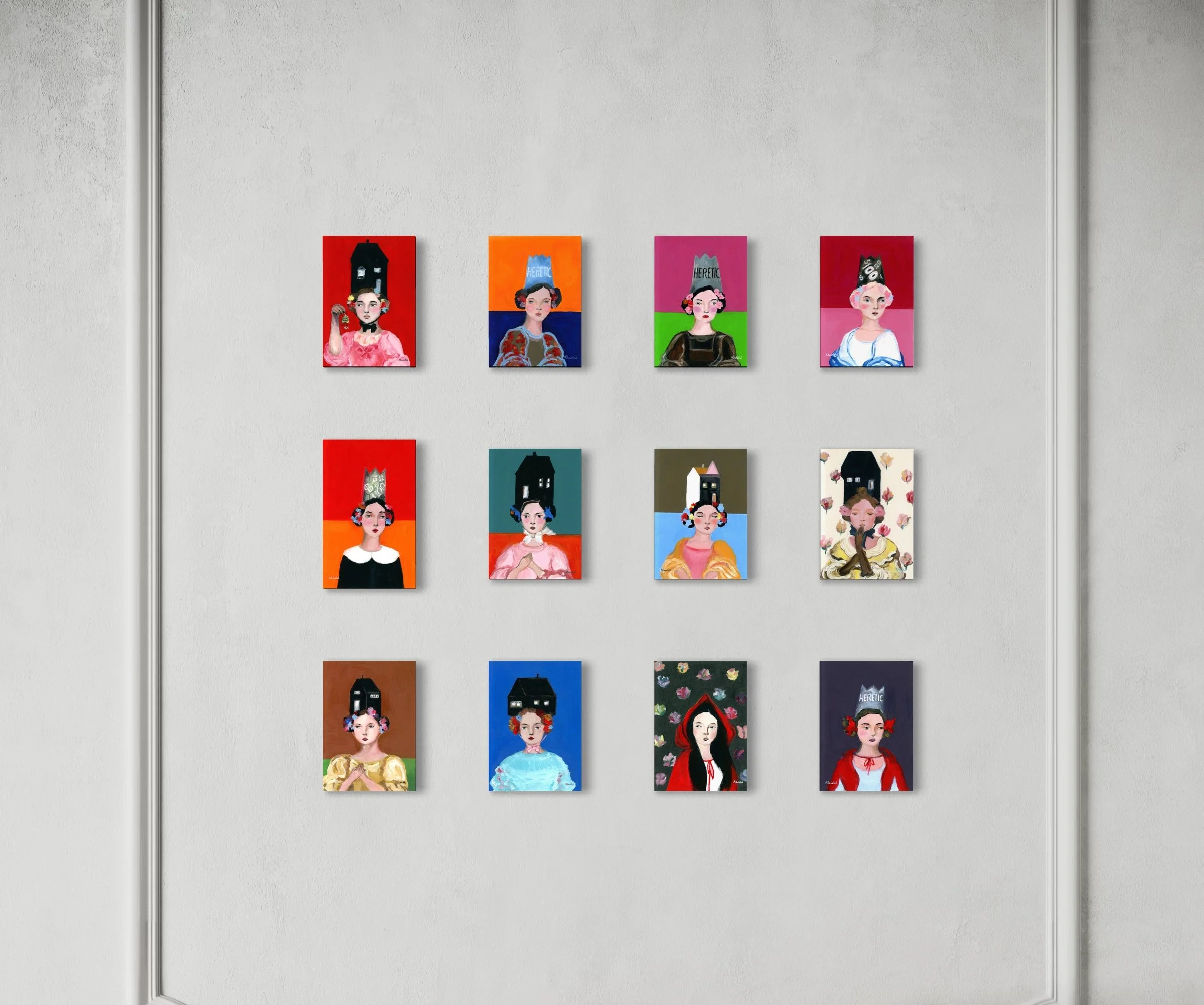
They Drink From Flowers
A collection of tiny portraits
There’s a particular kind of quiet power in Alexandra Swistak’s women.
They could be small in scale but immense in presence - tiny portraits rich with colour, pattern, and symbolism. Their faces are calm, almost reserved, yet you feel entire histories passing behind their eyes. A crown, a hat, a house perched where it shouldn’t be; a bee hovering with impossible importance. Nothing in her work is loud, but nothing is accidental either.
I’ve been enamoured with these women for some time now. There’s a refined palette, a deep sense of inwardness, and an unmatched soulful sensibility that makes you lean in, as if you’re being invited into a story you weren’t supposed to overhear.
At Curio Atelier, we’re featuring Alexandra’s ongoing collection They Drink From Flowers, and this felt like the perfect moment to spend time with her world.
Moving, travelling, and the things that stay

Alexandra Swistak (Vancouver)
Oil on Canvas Board
10” x 8”
Alexandra’s life has never been static. Born in India and raised in British Columbia, she grew up with a lot of moving around, and by her second year of university she was already travelling widely through Europe and Asia. Those experiences didn’t just give her scenery, they built a visual vocabulary that keeps resurfacing in her paintings.
When she looks back at her work now, she sees a trail of recurring motifs:
“There have been countless iterations of significant collections that have run parallel with lasting experiences. Bees, figures, stripes, boats, hats, flowers, crowns, and money motifs… Hats, homes and boats, specifically, at times have morphed into very simplified or even abstract shapes.”
The houses and boats that appear across her paintings are not just props; they’re condensed symbols of movement, arrival, and the feeling of being both inside and outside at once. A hat can be shelter, identity, costume. A boat can be escape, migration, or the fragile container of a life in motion.
Her influences are deliberately wide-ranging: Flemish Renaissance, Mughal portraiture, Impressionism, Classicism, Cubism. And then there’s the image that lives rent-free in her mind: the Villa of the Mysteries in Pompeii, with its massive figurative frescoes. That sense of a room wrapped in continuous narrative has quietly shaped how she approaches her own large-scale works - figures surrounded by saturated colour and pattern, more like fragments of fresco than isolated portraits.
Colour that remembers

Alexandra Swistak (Vancouver)
Oil on Canvas
7” x 5”
Alexandra often talks about “visual habits” from the places that have marked her. India is the bright, unforgettable one:
“No other country does saturated color quite like India! Turmeric yellow, burnt saffron orange, hot pink… so full of passion. Although it can overtake a piece too.”
Her palette, though, is more tempered than that first blaze of memory. Somewhere between India, Egypt, Morocco, and a deep love for European art history, her colours soften into something layered and lived-in. You can feel the heat and the dust, but also the cool of stone interiors and museum corridors. It’s not travel illustration; it’s a slow synthesis.
They Drink From Flowers: women, bees, and inheritance
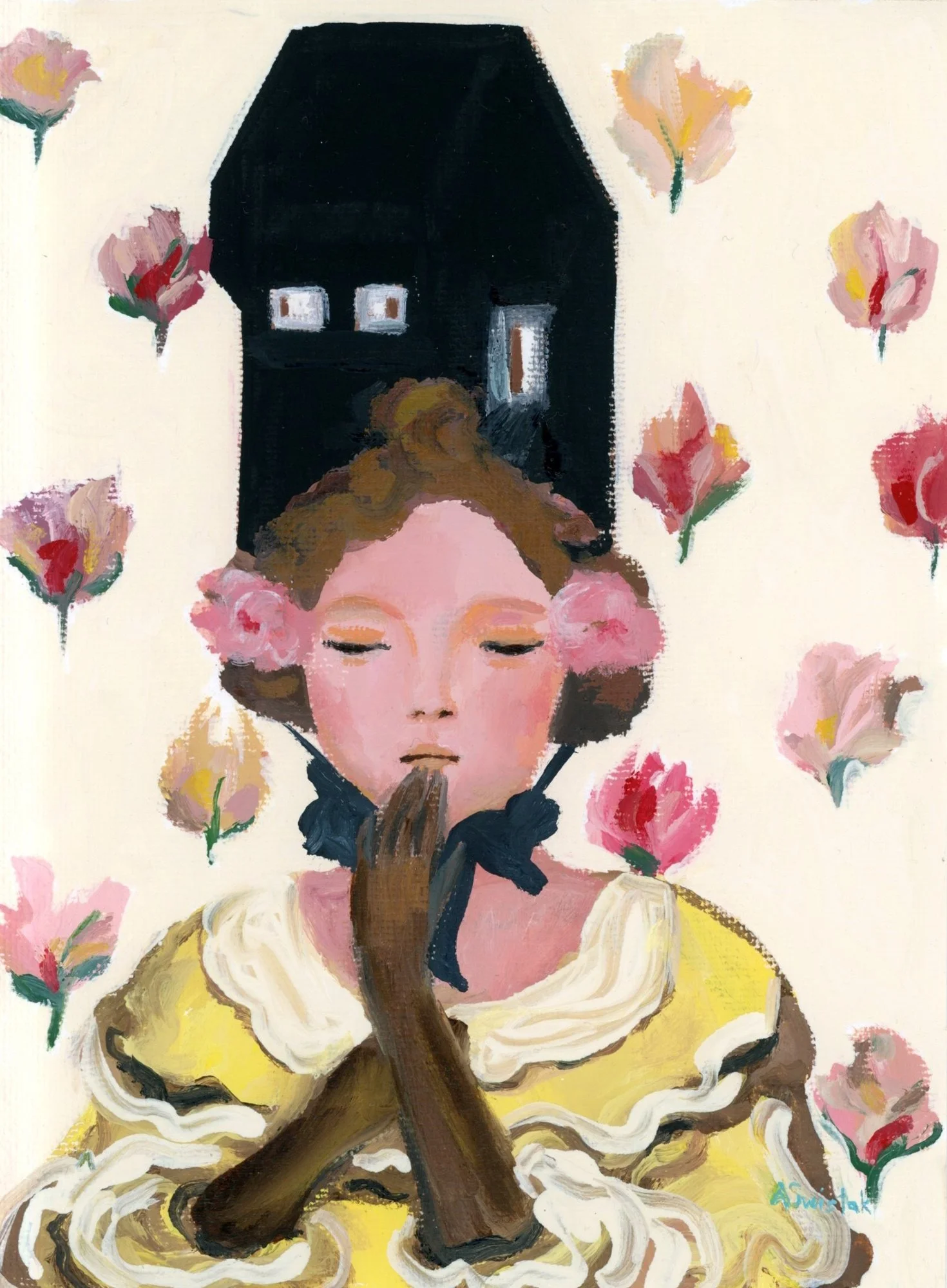
Alexandra Swistak (Vancouver)
Oil on Canvas
7” x 5”
The title They Drink From Flowers is both tender and strange. It sounds like a children’s line, but there’s something older and more mysterious underneath. When I asked where it came from, she went straight back decades:
“This came to me over 40 years ago. I watched the sunrise as I walked around Luxor Temple at 5 A.M. This idea began to formulate somewhere on that trip. However I feel it may have begun even earlier but I can't recall how or where.”
The women in this series are often accompanied by bees - on their bodies, near their faces, hovering at the edge of the frame. Bees for Alexandra are layered symbols: wisdom, labour, fragility, and the measure of whether an ecosystem is healthy.
“It’s both. I can't imagine a world without bees. There are ideas around technology for pollination, a sort of robot bee colony which is a very frightening thought to me.”
So They Drink From Flowers becomes, at once, ecological and intimate: a meditation on the lives of bees and the lives of women, on inheritance and care, on what we pass down and what we risk losing.
Girl with Bee: a companion who never ages

Alexandra Swistak (Vancouver)
Oil on Canvas
7” x 5”
Within Alexandra’s practice, “Girl with Bee” has become an established subject, almost like a recurring character who keeps returning in slightly different moods. Who is she now, after so many versions?
“She is the same, full of wisdom and innocence too. She never ages and she has so much more to share with me.”
There’s something deeply moving in that answer. Rather than treating her subjects as one-off images, Alexandra seems to treat them as long-term companions, figures she can visit again and again to see what else they have to say. The bee, in this context, feels like a messenger or a quiet witness: small, persistent, essential.
Protecting the female gaze

Alexandra Swistak (Vancouver)
Oil on Canvas
7” x 5”
Alexandra frequently speaks about her fascination with the female gaze, but when we talk about how she paints women, the conversation quickly turns to boundaries. She listens closely to her collectors - there can be many conversations around a new body of work, and she values that exchange. But there is a line she will not cross:
“My work will not be influenced by others' input or ideas. The end result will still be whatever is meant to be. Otherwise I would be obeying and I am not an artist who will obey. I am not a wife, a mother, daughter, aunt, friend or sister who will obey.”
In other words, what she is protecting isn’t just how women are seen in the finished painting; she is also protecting the internal process that brings them into being.
“Perhaps I am protecting my voice as well as my artwork by always painting what I dream or see in my mind.”
Her figures feel poised between the past and the present: they carry echoes of historical portraiture, but there’s always a modern edge: a slightly challenging eyebrow, a contemporary haircut, a gesture that belongs to now.
“I do this all the time. I might use Matisse-inspired cut outs and have a portrait with an expressive questioning or challenging raised eyebrow. I like sensitive and equally strong characters.”
That duality - sensitivity and strength, obedience refused while grace maintained - is part of why these women feel so quietly powerful.
Work that evolves over long days

Alexandra Swistak (Vancouver)
Oil on Canvas
7” x 5”
Behind the poetic titles and delicate surfaces is a very grounded, disciplined studio practice. Alexandra is candid about working ahead of season, juggling admin with painting, and the reality of needing uninterrupted time for ideas to unfold.
“I block 8 to 14 hours of uninterrupted painting. It's absolutely necessary for an idea to grow. I feel fulfilled when I give something sufficient time to evolve.”
Most of her paintings feel personal, even if the figure looks nothing like her:
“I'm often told my portraits look like me even though to me, they don't. There is an inner life, fleeting moments, past experiences that somehow flow onto a canvas.”
It’s an inner autobiography written through other faces - women who may not be Alexandra in likeness, but who clearly carry parts of her history, questions, and memories in their posture and gaze.
Where her women like to live
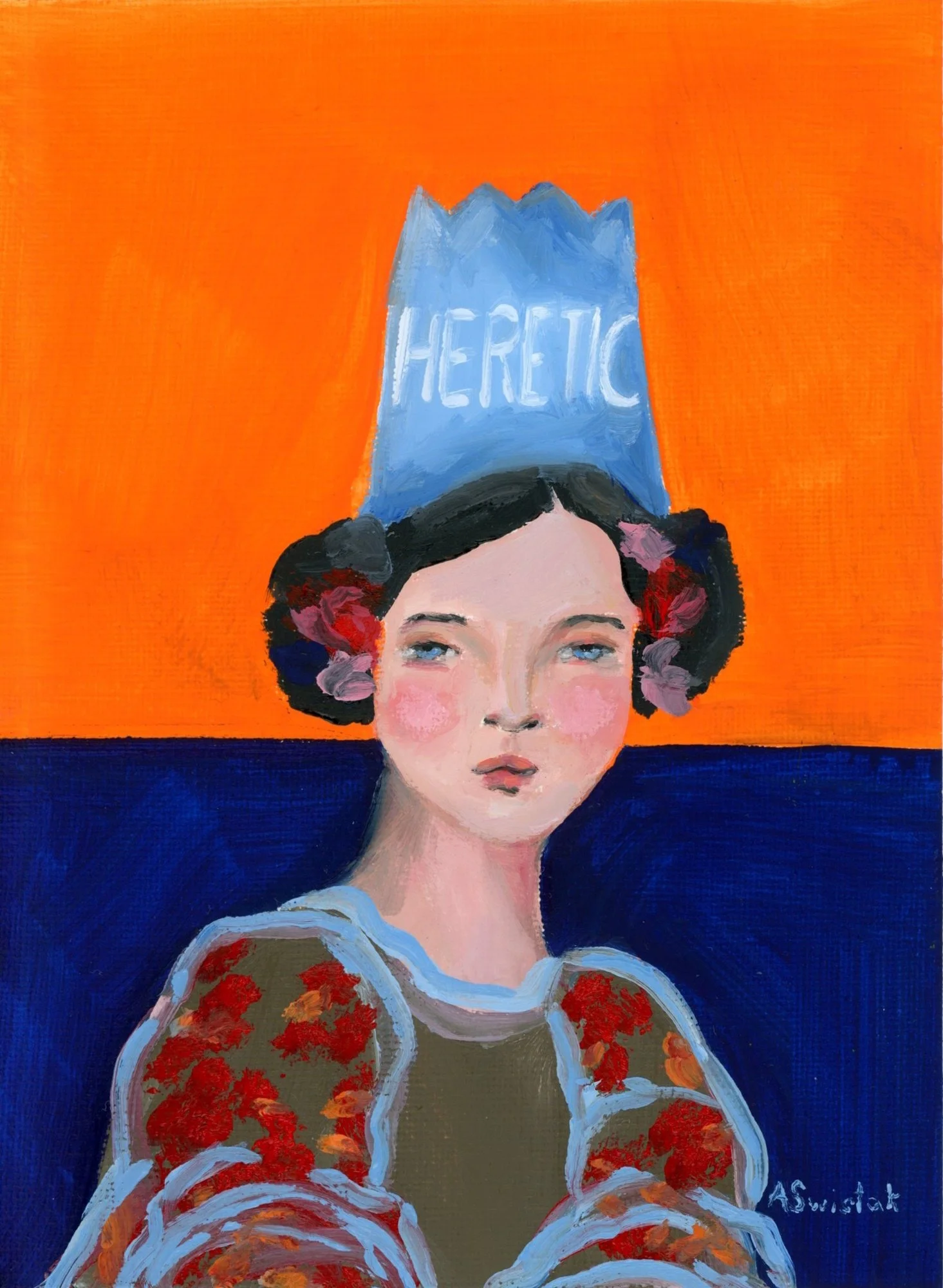
Alexandra Swistak (Vancouver)
Oil on Canvas
7” x 5”
One of the things I love about Alexandra’s practice is how relational it is. When I ask where she imagines her paintings living, she doesn’t answer in abstractions; she talks about actual people:
“I don't have to imagine as I know most of my collectors. I truly value building relationships with my art collectors. It's a gift to receive photos of where my artwork lives.”
This fits so naturally with how we think about collecting at Curio Atelier: art as something you live with, not just something you acquire. Many of Alexandra’s works are small - intimate portraits that can sit above a reading chair, near a bedside table, or in a hallway you pass twenty times a day. They’re the kind of pieces that quietly accompany you, offering presence rather than spectacle.
The women in They Drink From Flowers don’t shout for attention. They hold it. They keep their own counsel while inviting you to bring your own stories to them. There is colour, symbolism, and history, but also a softness that feels very human.
If one of Alexandra Swistak’s ladies has stayed with you after seeing it once, that might be your sign. As Alexandra herself knows from the photos collectors send back, these works don’t just decorate a room; they shift its emotional temperature, adding a quiet, soulful strength that’s hard to forget.