
Artist Focus: Jackie Bradshaw
Wild inner worlds, painted houses, and small escapes that look back at us
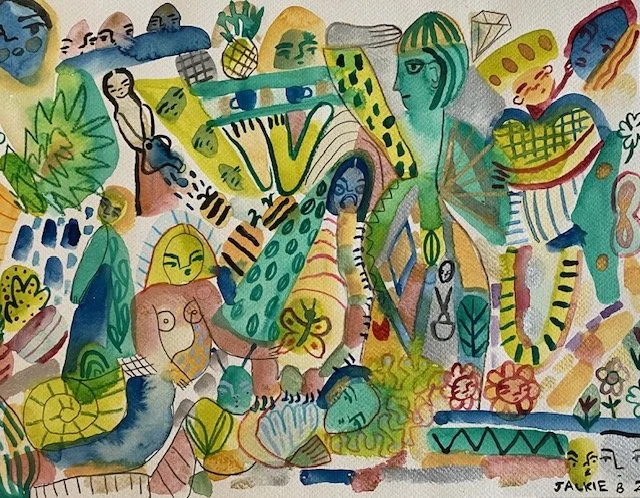
Jackie Bradshaw (Kitchener, ON)
Mixed Media on Paper
11” x 14” (Unframed)
The first time I saw a Jackie Bradshaw painting, I had that very particular feeling: oh, there’s a whole world in there.
Her pieces are colourful and bold, packed edge-to-edge with rivers, houses, owls, bicycles, angels, faces peeking out of windows and bushes. At first glance they feel like wonderful escapes – the sort of scenes you can disappear into when real life feels too sharp – but if you sit with them, they start to reflect reality back in a very honest way. Her worlds are playful, yes, but they’re also about grief, chronic illness, resilience, and the stubborn decision to keep going.
Jackie calls herself a self-taught folk and outsider artist and lives in Kitchener, Ontario. You can feel that “outsider” position in the best sense: someone standing a little to the side, watching, noticing, and quietly recording when others walk past.
The child’s eye that never quite went away
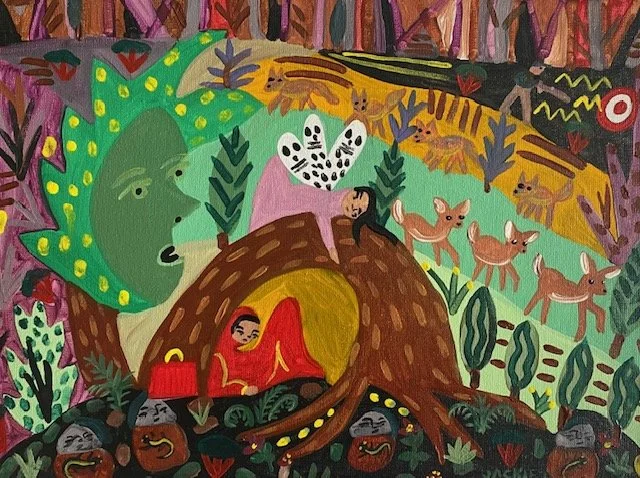
Jackie Bradshaw (Kitcher, ON)
Acrylic on Canvas
12” x 16”
As a child, Jackie was a “wildling,” roaming rivers and forests and finding faces in clouds and wood panelling. That way of seeing never really left – it just moved onto paper, board, and eventually, walls.
“I notice this most in all the unexpected parts that come out in a painting,” she told me. “If I begin painting one thing and some sort of person or creature appears, I have to embellish and bring it forward. It’s like when you’re a kid and a pile of clothes in the dark looks like a bear.”
That sense of discovery is all over her work. Figures and creatures seem to push through from another layer of reality, and she lets them. Her paintings feel less like tightly pre-planned compositions and more like maps of what appears when you stay long enough with the paint and let your imagination misbehave.
Painting to keep the demons at bay
Jackie has been candid about living with neurodivergence and chronic illness, and how painting helps “keep the demons at bay.” When I asked if there was one painting that really held her together during a difficult stretch, she immediately thought of one she no longer owns.
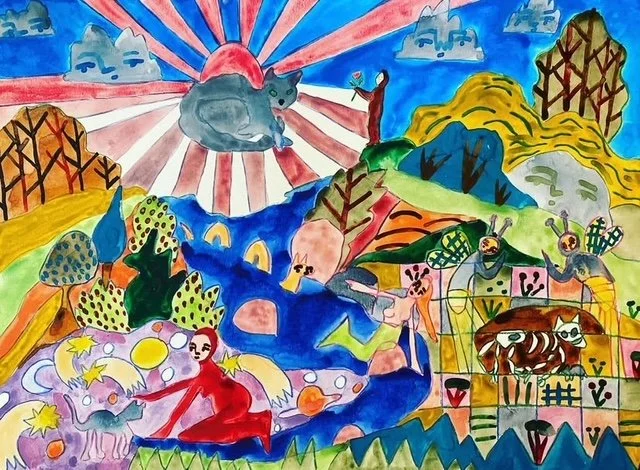
She made it after her beloved cat and best friend, Vapour, died.
“I was having a really hard time processing this grief,” she said. “I recall it bringing me peace. I sold this painting, but I wish I hadn’t.”
It’s a small, telling detail: for Jackie, the paintings are not just images to send out into the world; they’re also tools for survival, things she turns to when emotions or physical pain become too much.
When people with their own mental or physical struggles tell her they see themselves in her work, she doesn’t expect the paintings to fix anything. But she does quietly hope they offer something words often can’t: “I hope my work will bring them a sense of wonder and makes them smile, and distracts them for a bit from their pain.”
A house that becomes a painting
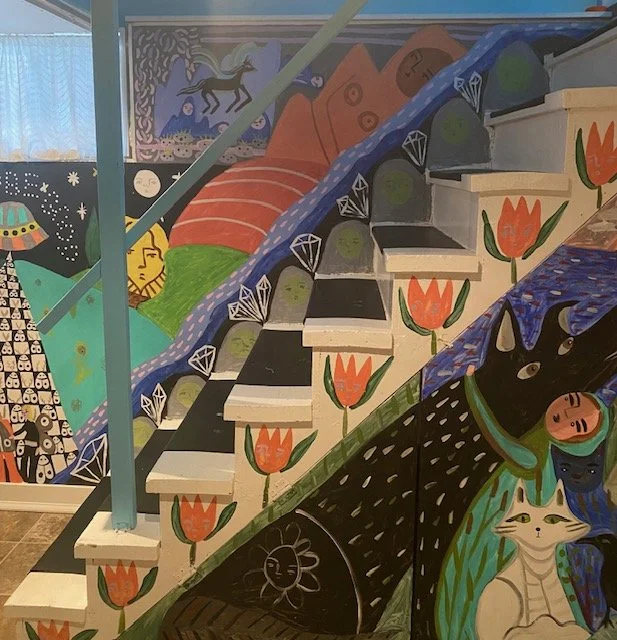
One of the most endearing pieces of Jackie’s story is her home. She is, quite literally, painting the entire house – walls and all – in a Maud Lewis–style outpouring.
“Painting the walls gives me the opportunity to make bigger works of art,” she said. She tends to work on the walls when she’s feeling good, so they become a record of better days: “Most of these works turn into a celebration of my life.”
She loves the physical sensation of it, too: the smoothness of painting on a hard surface, the way it feels different from paper or canvas. “It just seems natural that I would paint my walls,” she adds. “I feel Maud probably felt the same way.”
When she thinks back to visiting Maud Lewis’s house, it’s not some grand gesture that stuck with her but a tiny, practical detail: “I often think about the flowers on the bread box and how every time her and Everett made a sandwich they got to see this bit of cheer. I love sandwiches!!!”
It’s such a Jackie answer – joy and humour woven through a very real understanding of how small, repeated moments of colour can hold a life together.
Hiding, then stepping out of the hood
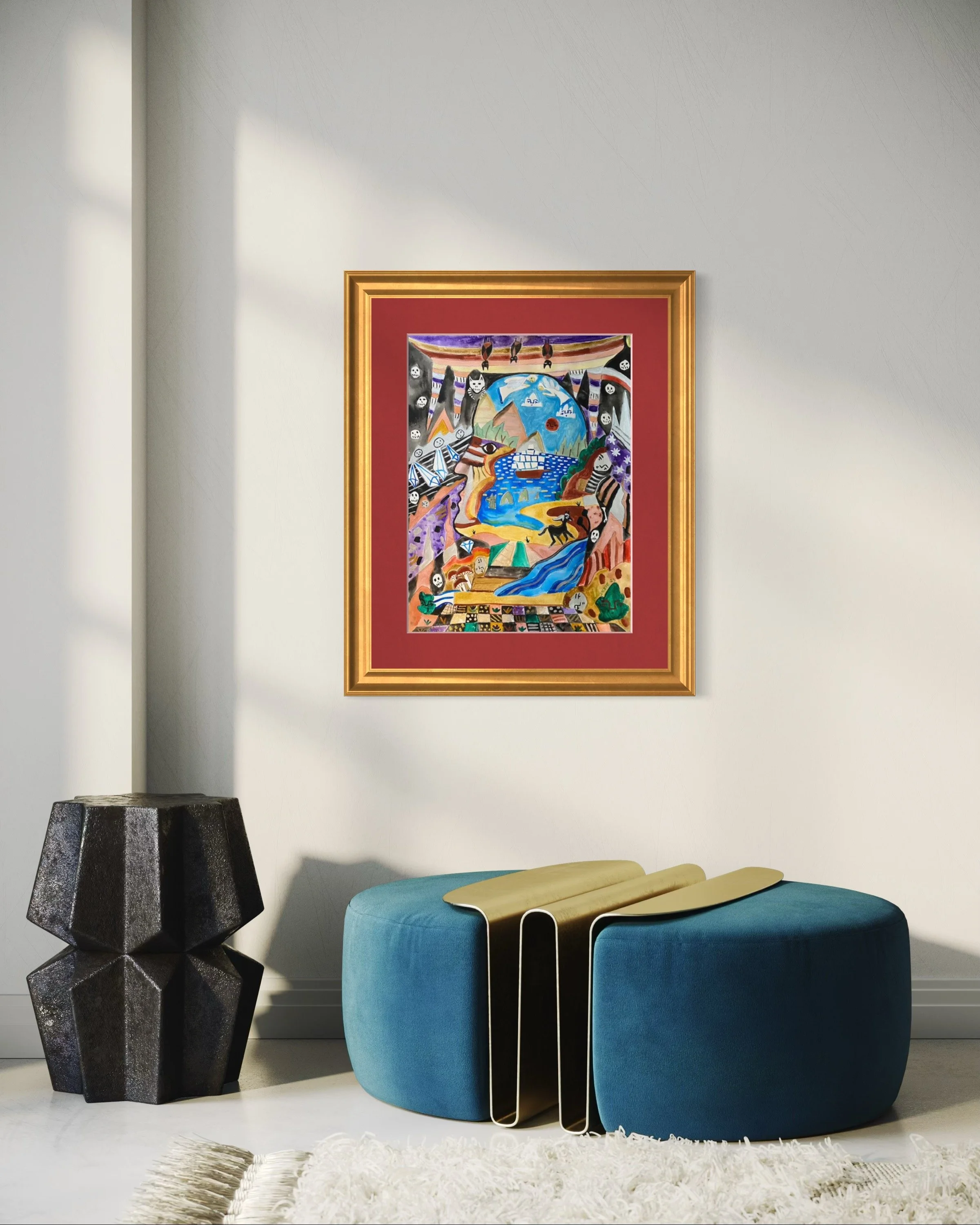
Jackie Bradshaw (Kitchener, ON)
Watercolour on Paper
24” x 18” (Unframed)
If you look across Jackie’s work over time, you can see a quiet shift in how she paints people – mostly women, and often, by her own admission, extensions of herself.
“When I first began painting, all my people wore a similar long tunic with a hood,” she explained. “All you could see of them was a circle where their face was – kind of like a long one-piece hijab.”
That uniform was a safe place, a way to hide and blend into the background. It was also practical in a symbolic way: a way to regulate temperature and protect herself from the elements in paint, when real life felt less controllable.
“Eventually I stepped out of this uniform in my paintings and began painting more exposed or nude women,” she said. “I’m not sure how or why this happened, but I think it has something to do with aging and trying to find a way to be more comfortable in my skin and to stop hiding so much – or just the desire to be able to be carefree.”
That tension between wanting to disappear and wanting to be free runs quietly through her work. Pieces like Stepping Out of My Cave feel especially personal. She made it after a long period of illness, when she was ready to start “building herself up again.” With chronic illness, that stepping-out is never a one-time event: “You get knocked down and then you have to keep picking yourself up again and again.”
Owls, birdwatchers and the small moments that hold the universe
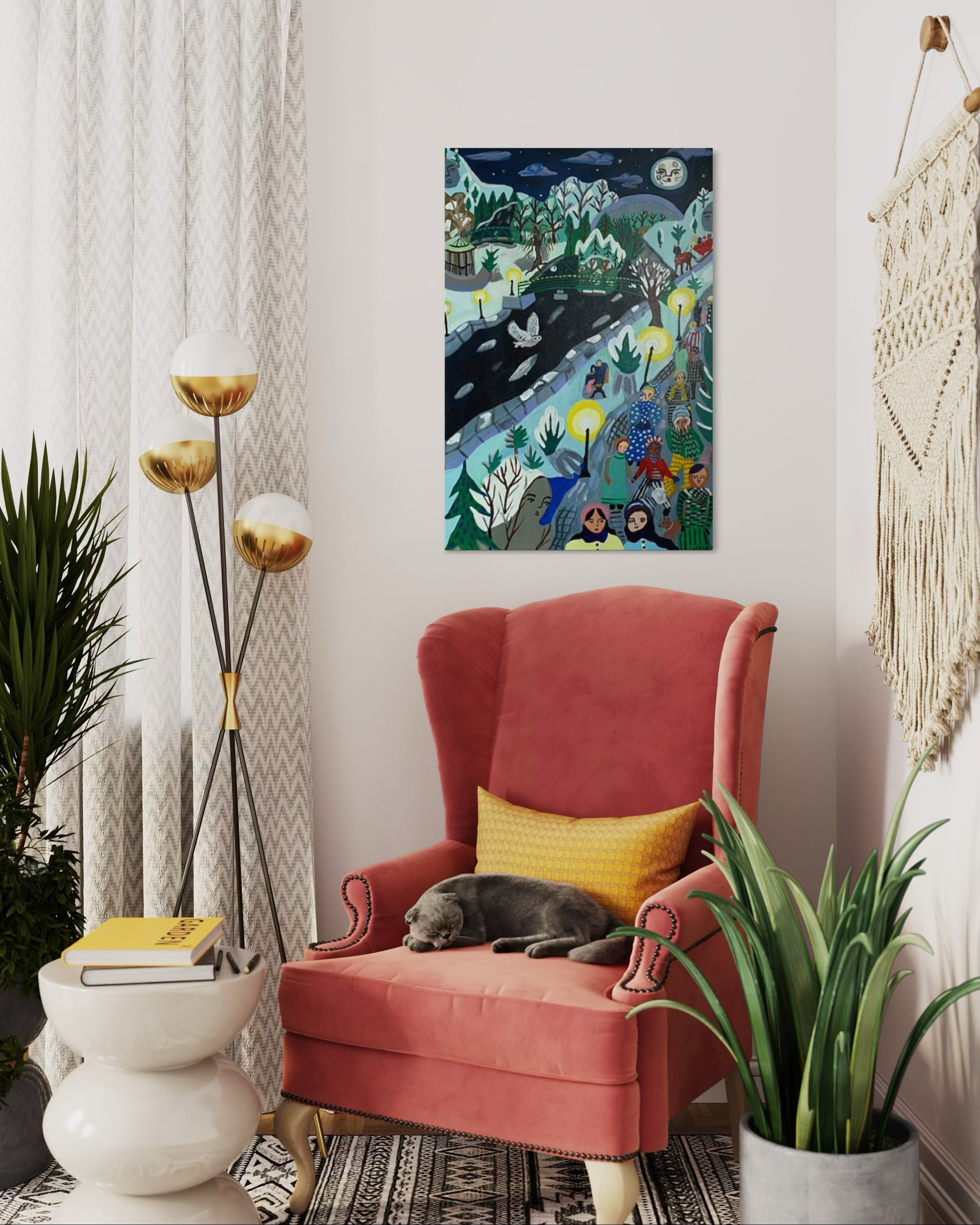
Jackie Bradshaw (Kitchener, ON)
Acrylic on Canvas
36” x 24”
Jackie’s paintings are full of animals and observers. In Snowy Owl, for instance, she doesn’t just paint a symbolic bird in an empty sky.
“On one side of this painting there is a crowd of beautiful people enjoying their night together,” she told me. “Then there are two people on a bench engaged in what I like to think is a life-altering conversation. Only they notice the owl in this moment. It was their turn. The others will see it another time.”
It’s a lovely way to think about those flashes of magic in everyday life: not everyone sees them at once, but they’re there, waiting.
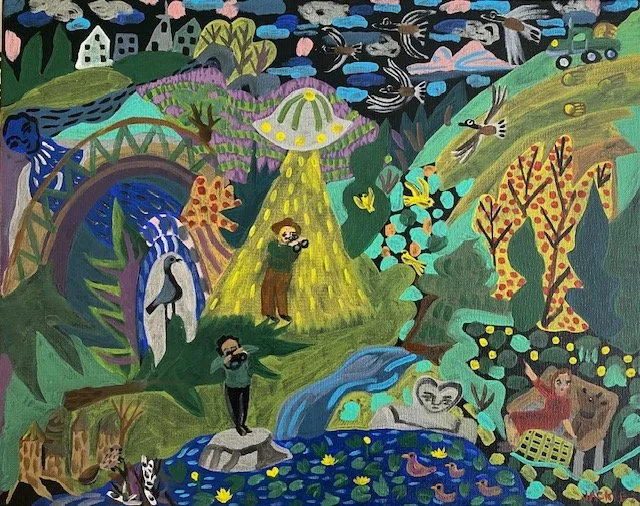
Jackie Bradshaw (Kitchener, ON)
Acrylic on Canvas
16” x 20”
In Watching the Bird Watchers, the humour is more obvious. Jackie spends time in a local park during migratory bird week, where hundreds of birds share the space with hundreds of humans in binoculars. “Lots of the time I enjoy watching the people as much as I enjoy watching the birds,” she said. “Human behaviour fascinates me! Ha ha. And yes, this is probably from the perspective of someone who has always felt like an outsider.”
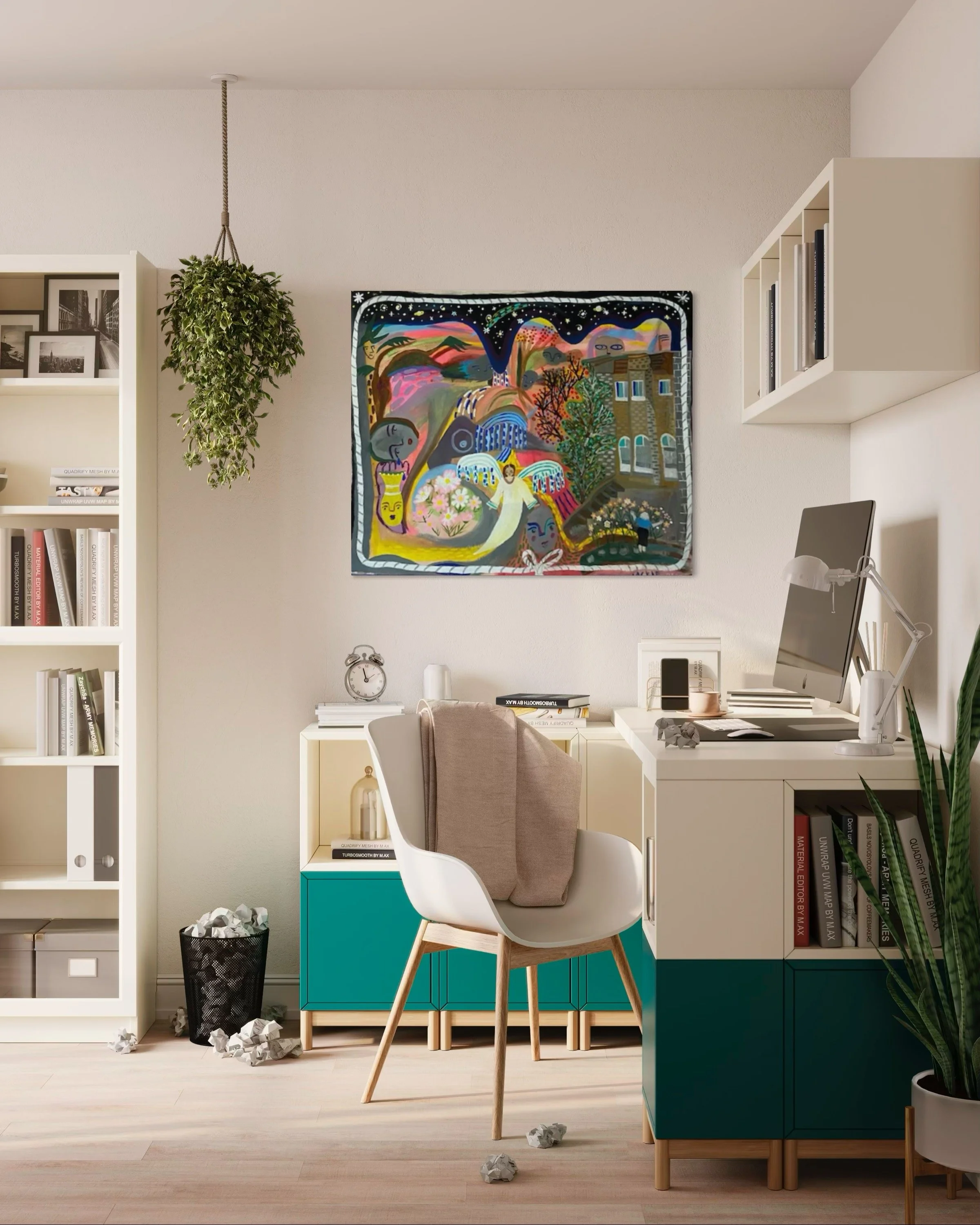
Jackie Bradshaw (Kitchener, ON)
Acrylic on Canvas Sheet and Fabric (Tapestry)
30” x 36” (Hanger not included)
Then there’s Taming the Cosmos, whose title suggests a grand, cosmic struggle, but whose origin is beautifully small and specific. It’s based on an elderly neighbour Jackie adores – the way she moves, dresses, and most of all, tends to her garden of cosmos flowers.
“Every year at the end of summer, when they are tall and drooping, she wraps a string around them to keep them upright,” Jackie said. “This bit of love and stewardship is basically the meaning of life on this earth, I think. She has figured life and the entire universe out by doing this small and simple task.”
It’s hard to imagine a more perfect metaphor for Jackie’s own practice: quietly binding together wildness and care in small, daily gestures.
Nests, kids’ rooms, and a more sustainable future
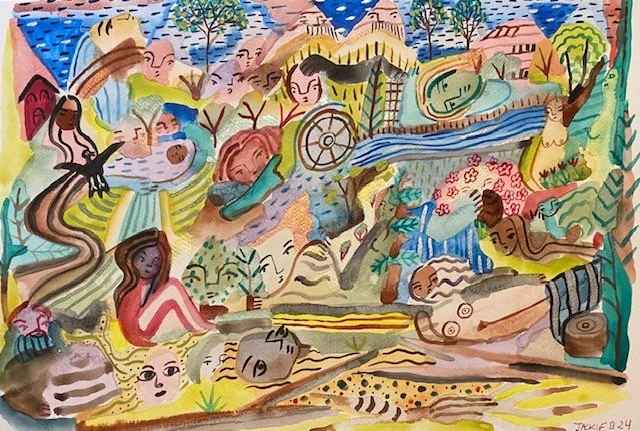
Jackie Bradshaw
Mixed Media on Paper
12” x 17” (Unframed)
Jackie describes herself as a homebody who cares deeply about her own nest. It makes her especially happy when her work ends up in children’s rooms.
“Lots of people buy my art for their kids’ rooms,” she said. “This makes me happy to think that my art will be a part of their formative years. But I like to think my art is for anyone who wants to believe in a better world where magic and serendipity is very much alive and well.”
At the same time, she’s in the middle of questioning her materials. She’s always used whatever was cheap and accessible, but now she feels tension between that and her desire to live lightly on the earth.
“I live most of my life with very little impact or footprint on the earth, so I feel I should align my practice more closely to this way of life,” she told me. “I don’t want art to feel like a vice or guilty pleasure. I would like to experiment with making my own supplies out of natural or recycled materials. Maybe even have a garden dedicated to paint making.”
Together with her friend Nadine, as part of The Creek Collective, she’s making a point of figuring this out in the coming year.
Ten years from now
When I ask Jackie to imagine herself ten years from now, still painting, she doesn’t talk about fame or career milestones. She talks about play.
“I’m curious to see ten years from now how my style has evolved,” she said. “I hope that more experience doesn’t refine my work too much… I hope my art remains playful and childlike. I hope I keep creating new worlds for myself and others to escape to. I am excited to see what new characters might emerge. I hope I can keep having fun with it.”
In the end, that’s what draws me so strongly to Jackie’s work for Curio Atelier: the way it holds fun and survival, escape and reflection, magic and everyday life all at once. Her paintings invite us into dense, imagined worlds – and, in doing so, they help us look a little more gently at our own.